2015 Shubha Suma Farmhouse, Adobe, Blog, Earth Plaster, Lime Plaster, Natural Plaster, Oxide & Lime Flooring

Eleven Thousand Sun Dried Bricks

“Of Three little pigs, one built a house of straw, another of sticks and the last built his house of bricks, Soon came the days of the big bad wolf, who huffed and puffed and blew the straw house down! He huffed and puffed and blew the stick house down, but try as he might, he couldn’t blow the brick house down. The other two piglets resented not having built a brick house and did so soon after, and they lived happily ever after.”

There are two blatant lies in this story, that is impressed on to the minds of many a children. One, that brick houses are better than straw houses and stick houses. Two, that a wolf (Canis Lupus) can ‘Huff and puff and blow the house down. Of these which we choose to overlook is completely left to us. Statistically speaking, the Straw houses and the wattle and daub constructions of many countries have been providing shelter in human settlements for centuries. However, the instance of a wolf blowing down a house has rarely (if not ever) been reported.
In a manner of speaking it was this metaphysical wolf that needed to be tackled when we took up the Sheegehalli Project.

The Premise

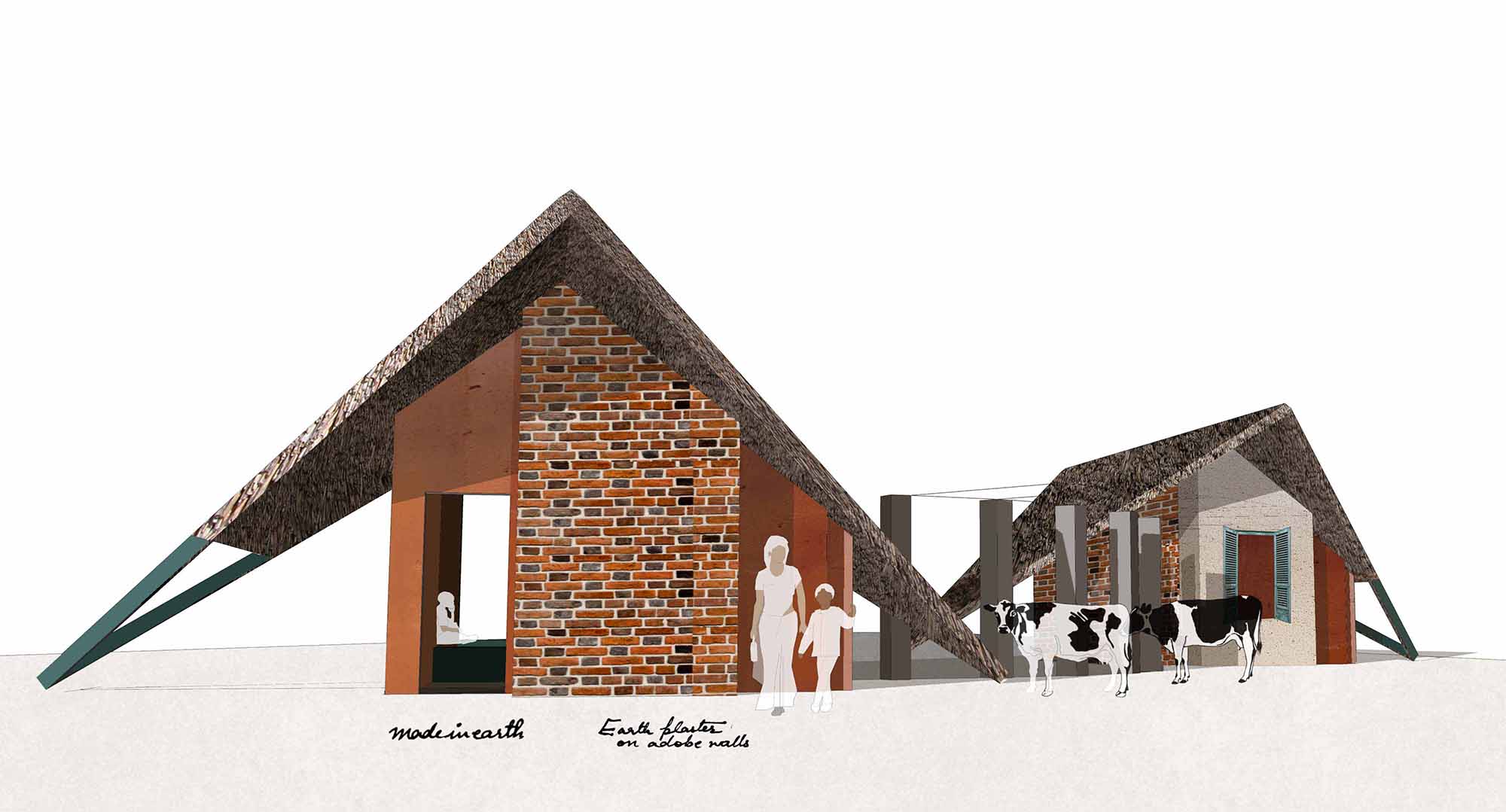
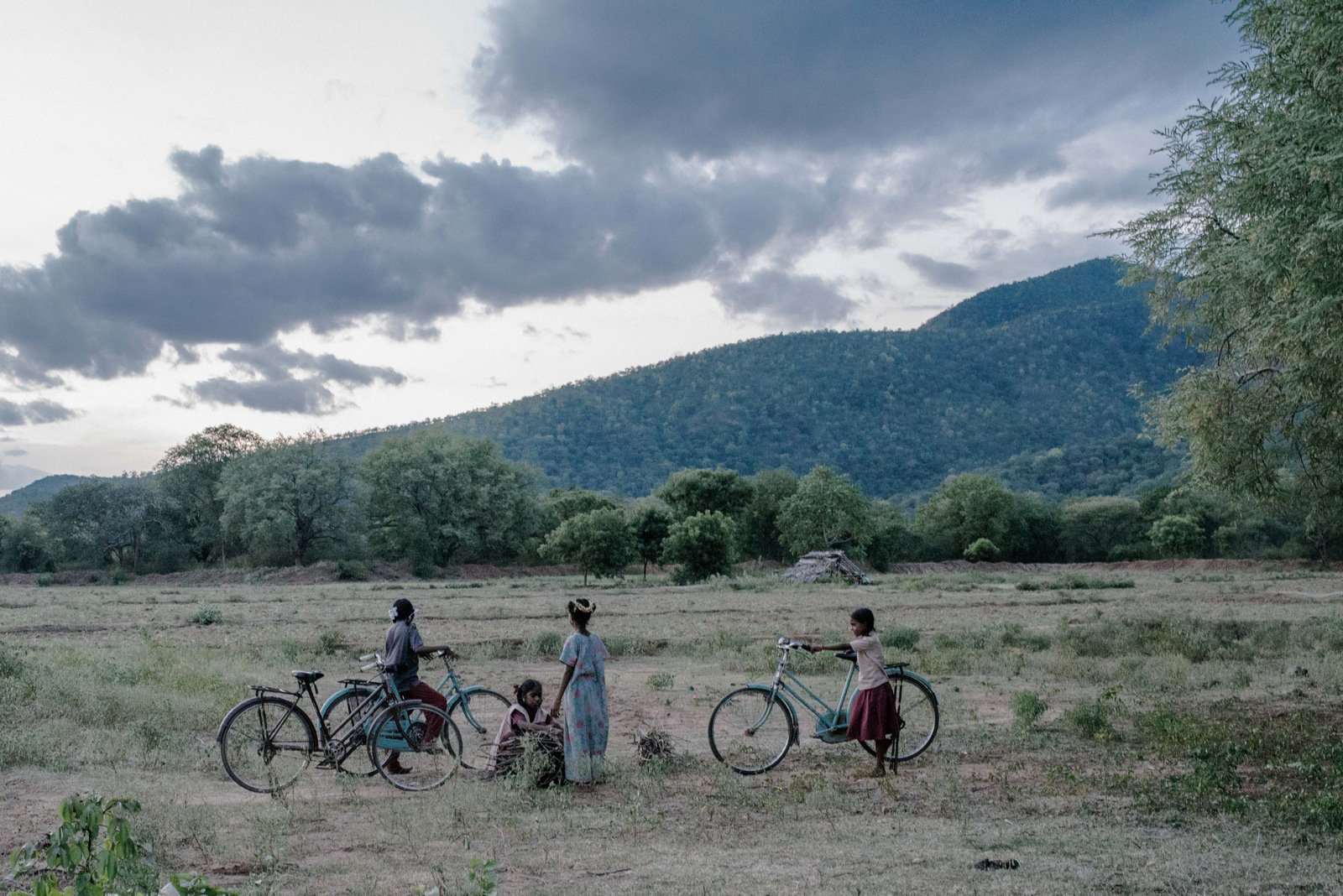
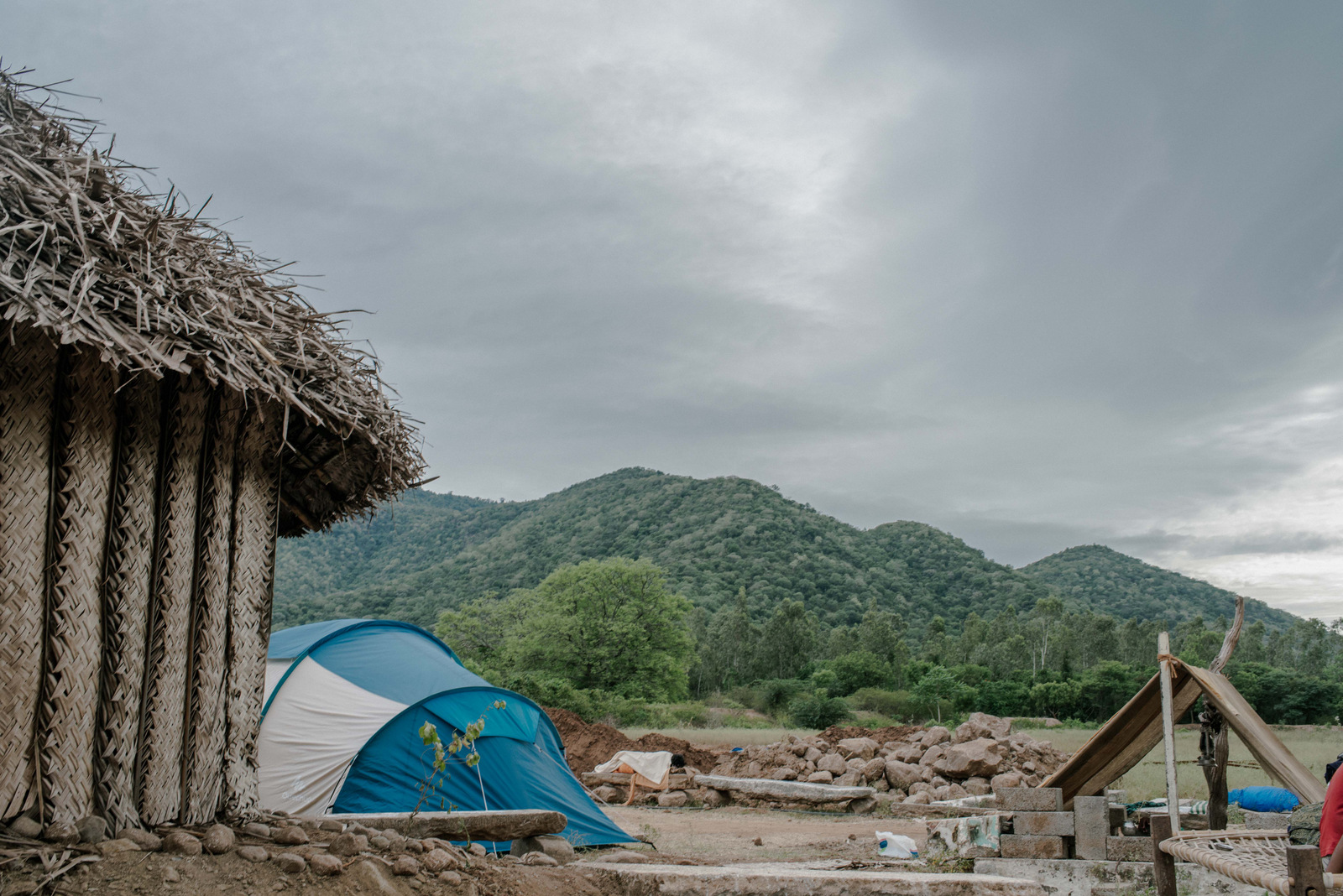
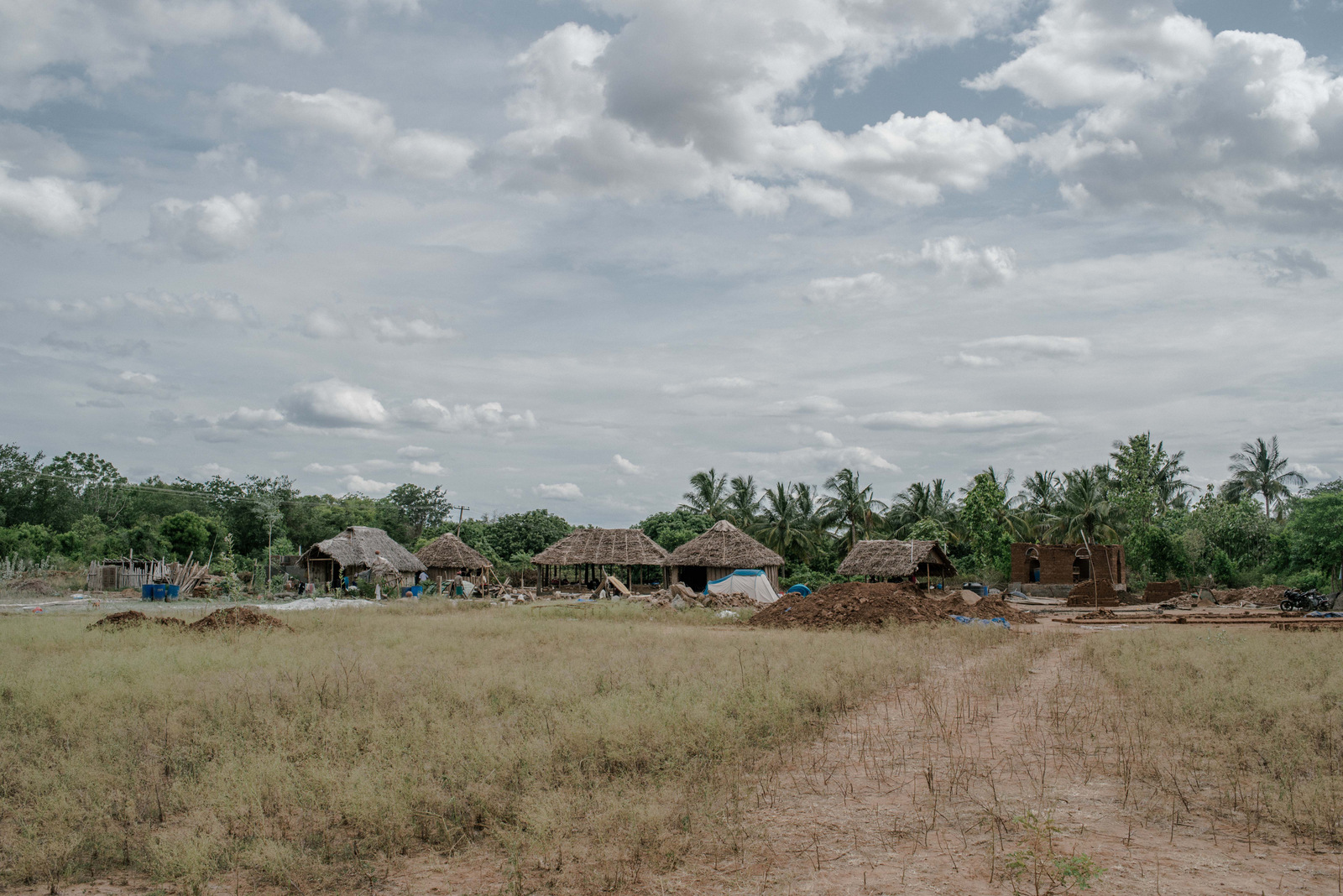
Sheegehalli is a small village located about 60 kms from the northern tip of Bangalore. A kilometer further away from the village, on a long strip of land is where our clients decided to do some organic farming as well as build themselves a small cottage. Suma and Shuba both work in the city and are looking forward to a quite retreat where they can both look forward to a little organic farm. Being organic farmers at heart, the two wanted a natural home to live in, where cement, paint and other man made chemical use is pushed to a minimum. This is where the project starts in all earnest, for it begins far from the city as we know it, in the outskirts of a village that is tangled in its customs, beliefs, work cultures, building practices, farming, cultural knowledge and what not.

The Brick Makers

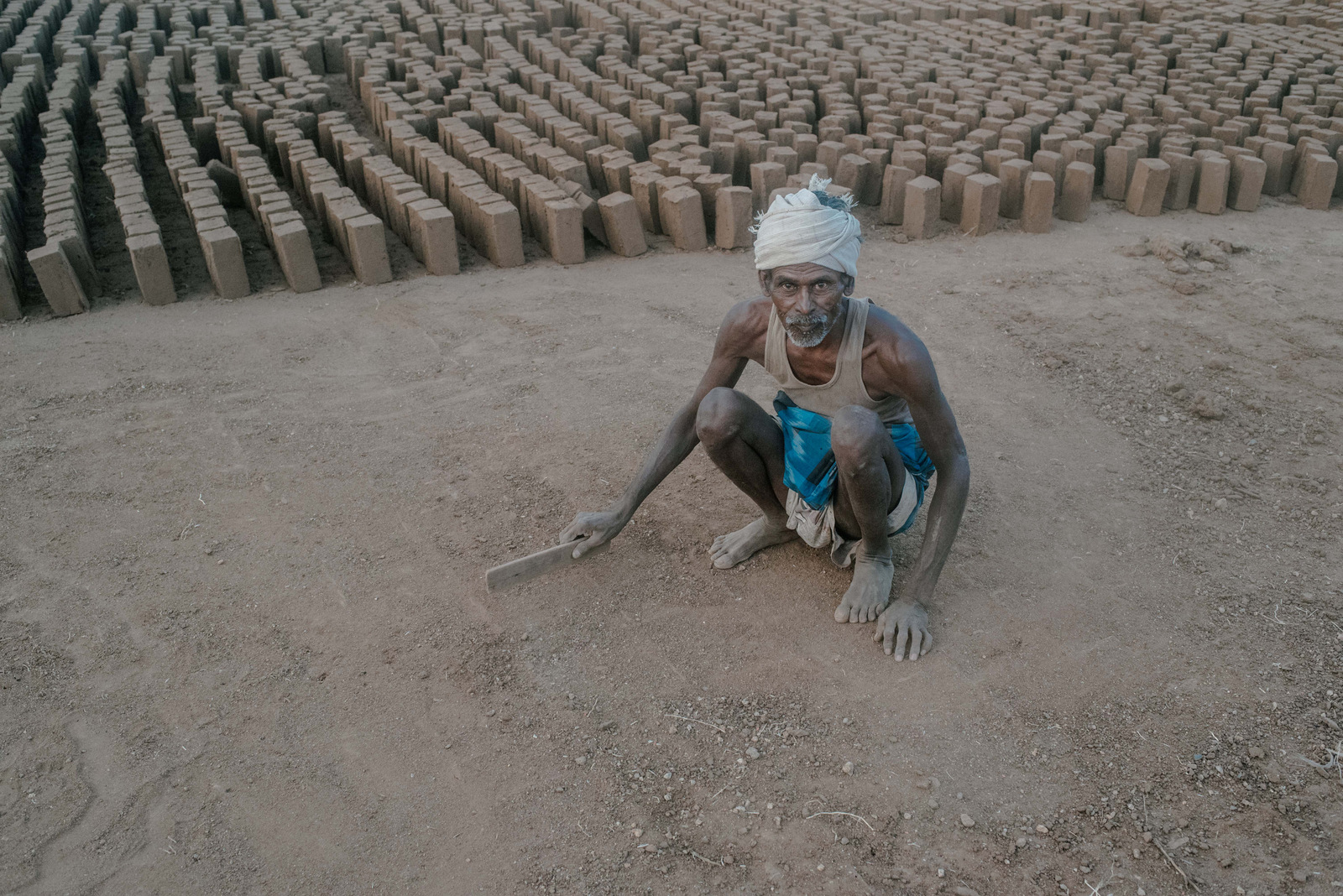
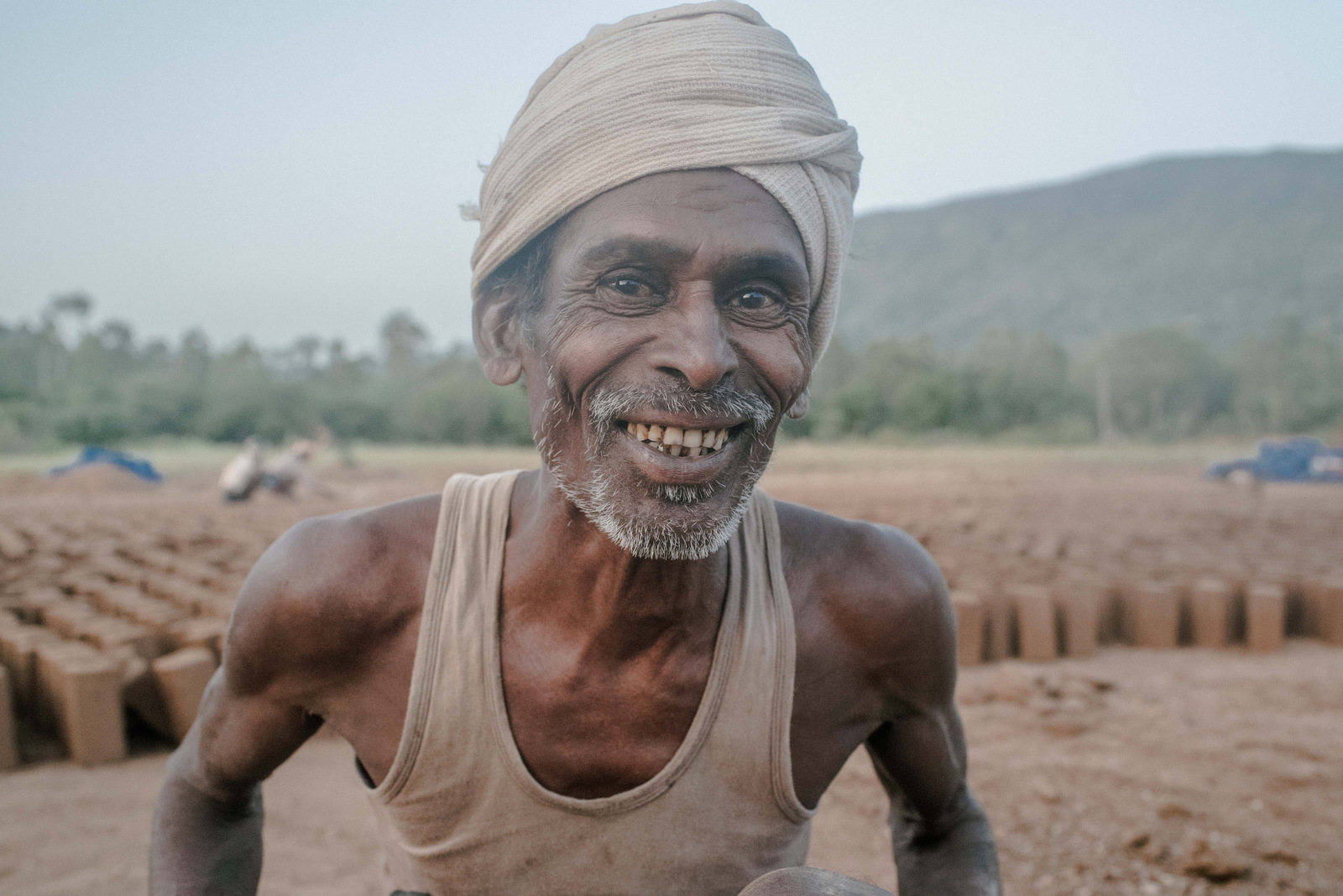
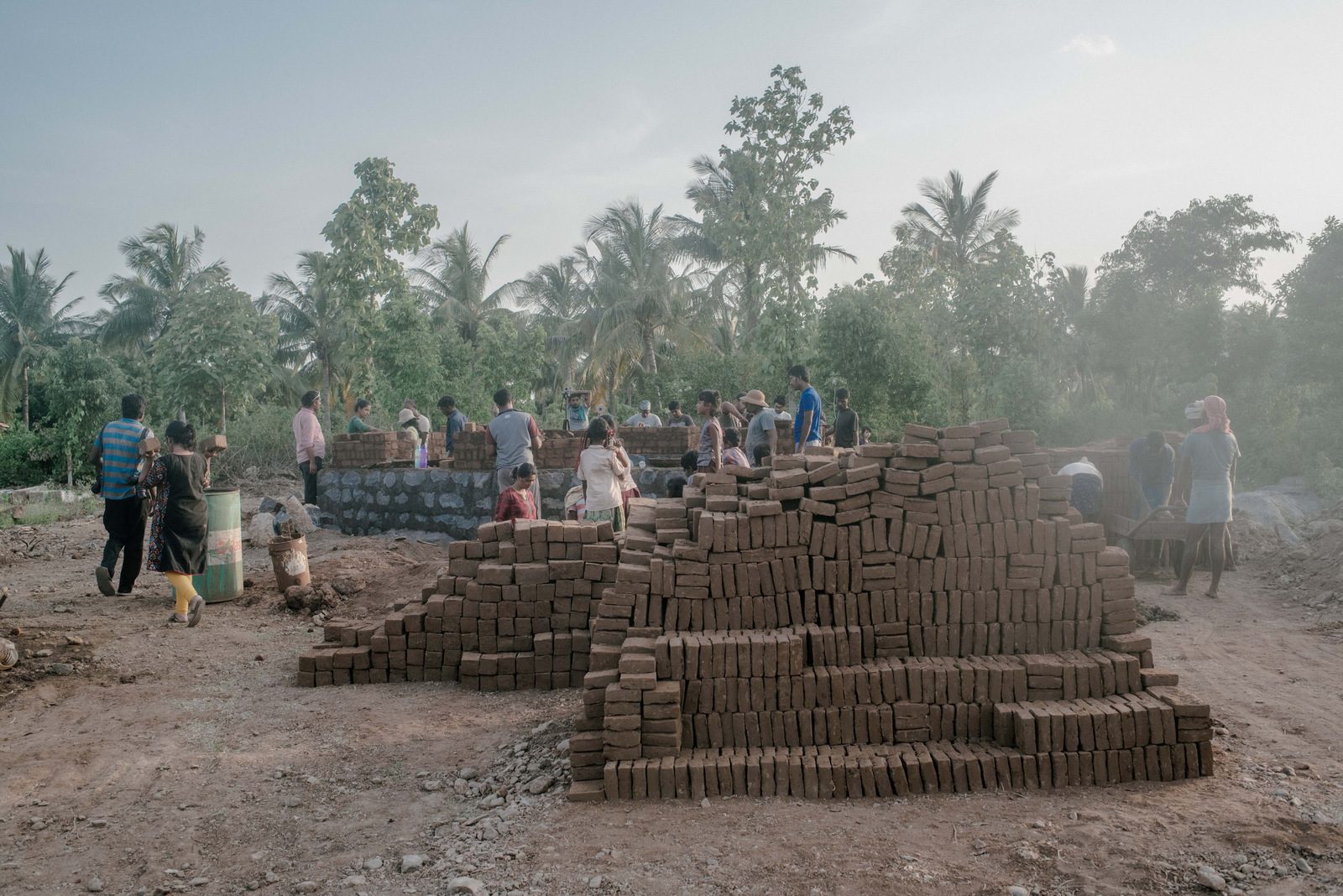
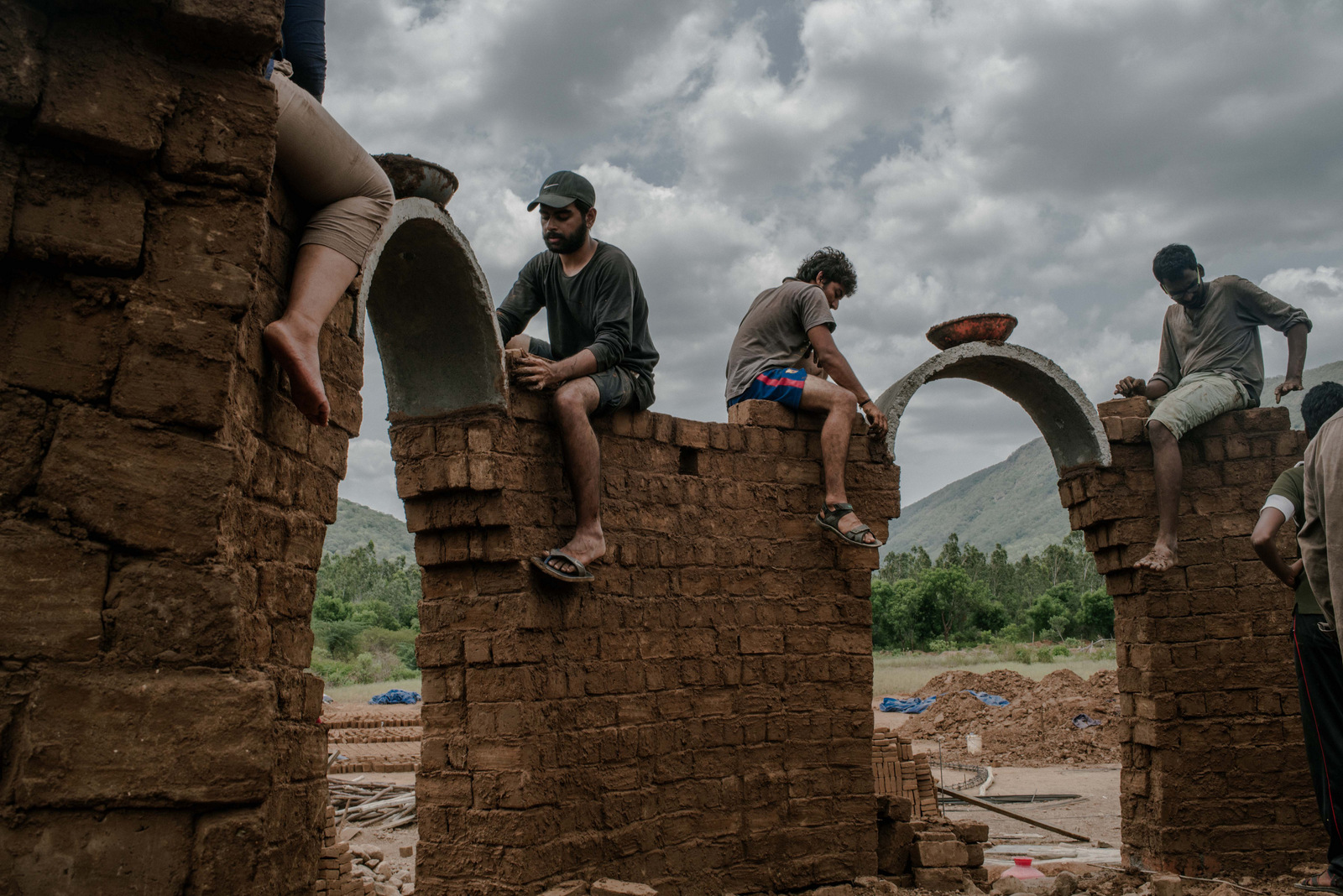
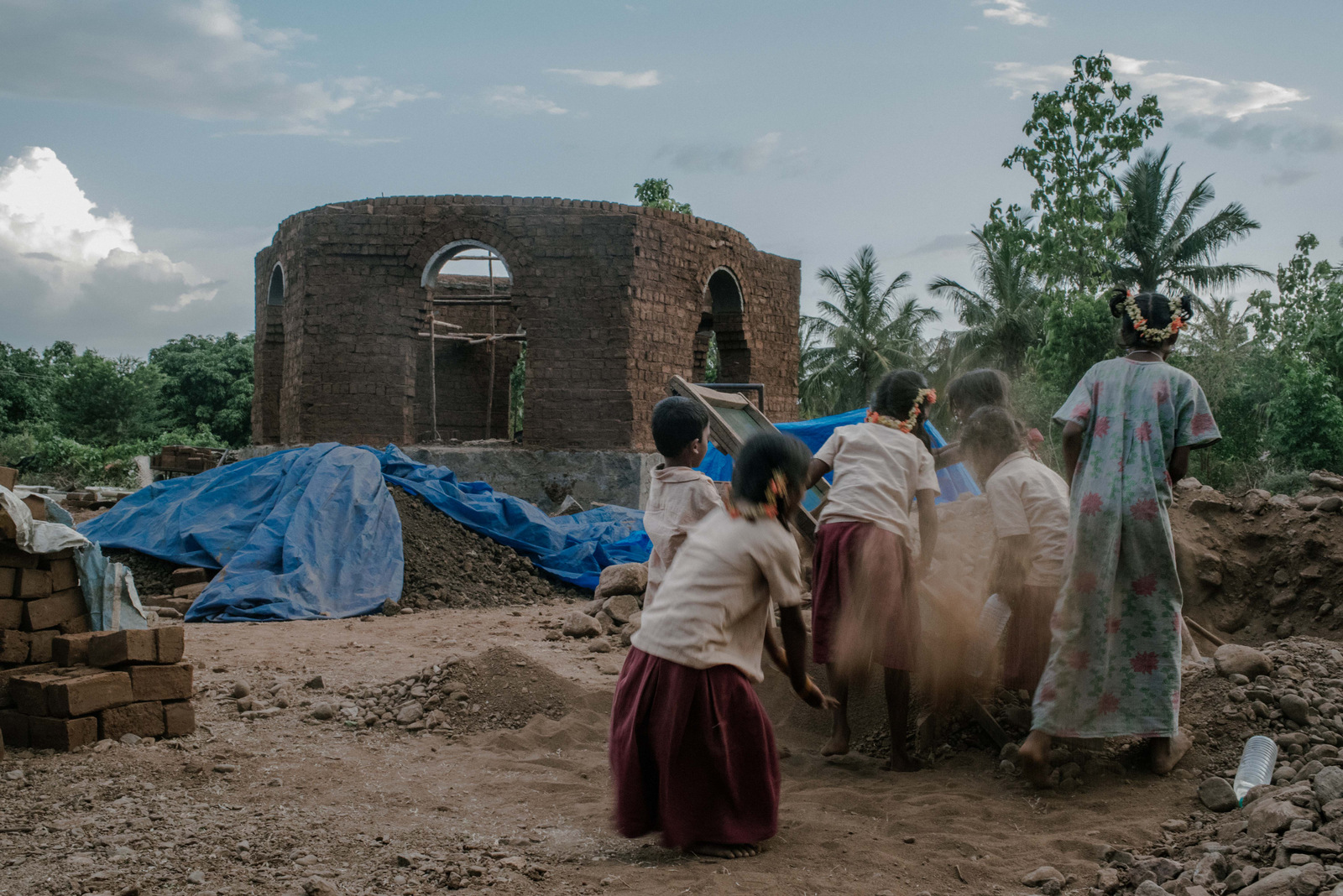
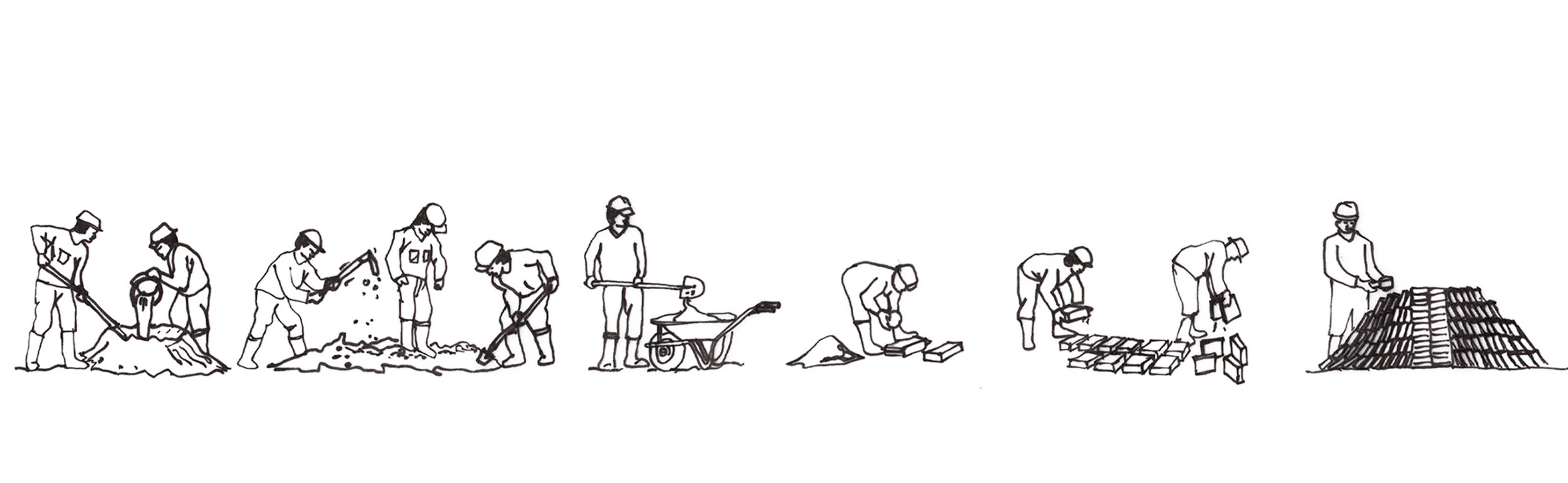
Munshamappa was a swarthy fellow, the kind of person who you wouldn’t come in the way of. Yet as his personality unfolded, he seemed more and more a sensitive and sensible person. Hesitance prevailed over our first meeting as we explained to him that we needed him to produce around 11 thousand sun dried bricks. The hesitance did not stem from the quantity of bricks or the one week deadline, but from our choice of un burnt or un cooked bricks itself. Now Munshamappa has been making bricks for over 40 years since the tender age of 16. For a man whose memory of adobe production is overshadowed by the demand for fired bricks, it seemed as If we were mis-informed. He even tried to convince us to set fire to the pile of adobes to give it ‘some strength at least’. It was only after Jeremie got into the mixing pit and cast a few bricks that Munshamappa’s eyes widened with realization. We seemed to know what we were asking for, and what’s more, we spoke the same language of earth. The way Jeremie stacked the earth and checked the consistency of the mix was exactly how Munshamappa would do it himself. It was a bonding like no other, between a man from the mountains of France and another from the semi-arid dry lands of Karnataka. Neither spoke a common language apart from earth. It had taken only one gesture to turn the tables, he knew perfectly well how to cast adobes, he would spread sand on the flat land before he cast the mud into the molds, he explained in detail as to how he would cover the bricks lest they dry too fast. Of how he would work from 5 in the morning till 9 and again 5 in the evening till 10. Of how he would flip the bricks to the side in two days, or the rows and columns he would make on the ‘kana´ the flat ground on which one casts the adobe.
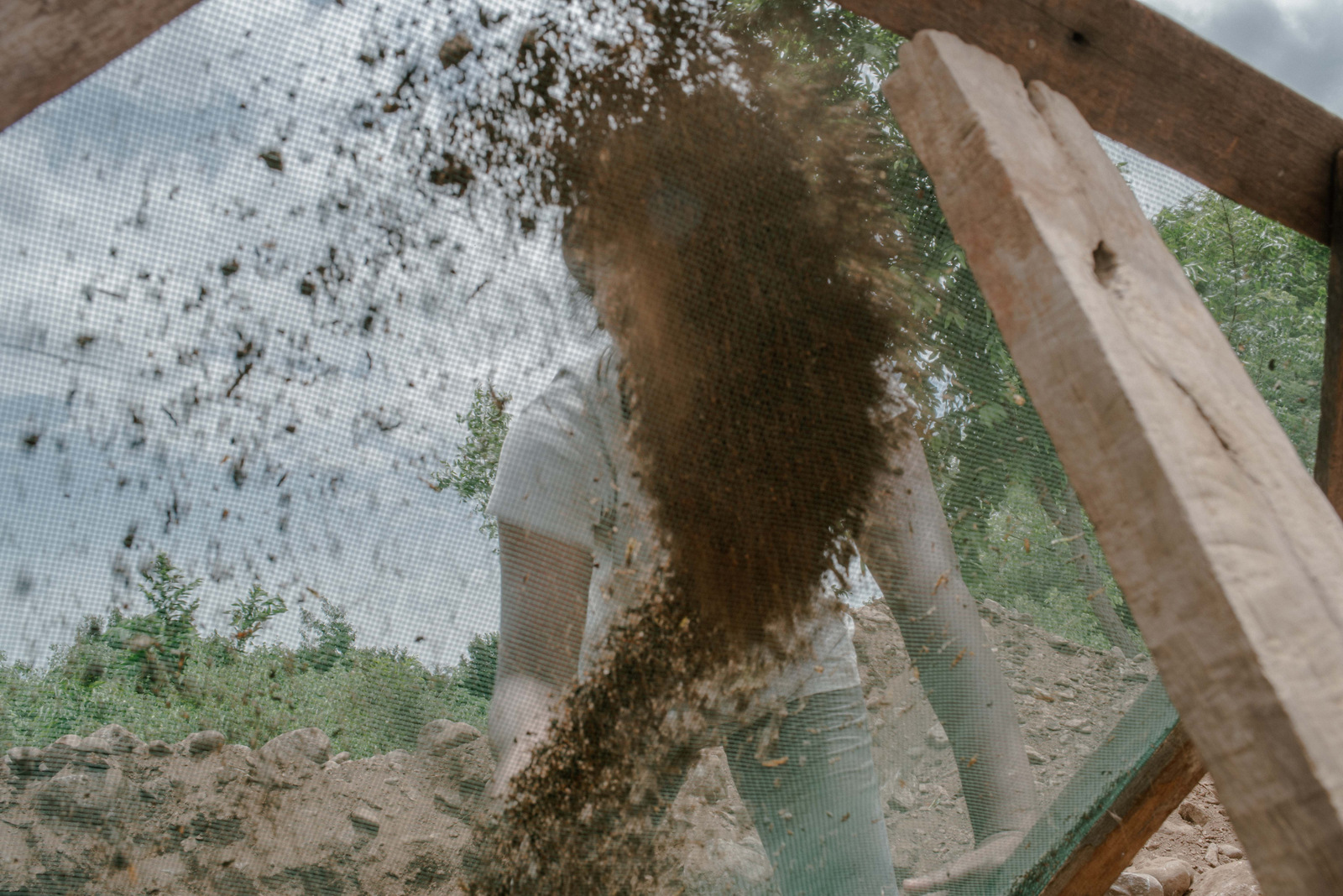
Rice husk, Quarry dust and Soil we told him, as he ruminated over how light the bricks were. ‘Olagade thamp aag irutthe’ he said (it will be cool inside the house) as we smiled at his understanding of the material.

The Master Mason (Mestri)

Shrewdness was probably just his professional trait. But it is most noticeable one when we first met Lakshmana, our local contractor. Lakshmana nodded at all the drawings presented to him and with a casual flick of head committed to wall sections that were detailed to the last brick. It took only three days for us to realize that he did not know how to read drawings, let alone drawings, he couldn’t read at all! Now, every site visit was marked by us creating demo structures be it the lost formwork to a beam or even the brick masonry. He was soon famed in the office for calling us and asking about “this wall” and “that wall” while frantically pointing at a spot roughly 70 kilometers away from us on the other side of the phone.
Though Lakshmana comes off as completely ignorant to natural building techniques, he is not. He is hesitant and unsure of building the way his forefathers taught him. This becomes glaringly obvious every time we explain the next step of the construction. If one were to explain to him the idea of mud mortar, he would complete the explanation by remarking that it would be better to leave the mix overnight, lest the clay doesn’t fully dissolve! Coming from a background where he cannot afford any financial risks, it is his trust in us and his enthusiasm to build that keeps him going on a path that he hasn’t walked before.

The Roofers

Visits to the nearby village, casual chats with familiar faces revealed that Suma’s dream of having a stone roof might actually be possible. A few enquiries and Suma driving to nearby stone quarys made it evident that there was an abundance of this material too! Stone roofs are the roofs of choice for ‘hulu-mane’ or vast rooms in the house used for silk worm rearing. On entering one of these spaces we were mesmerized by stones that spanned 16 – 18 feet! Another rendezvous bought us to Ullurappa- A man whose words were as strong as his material. We learnt that the span of a stone he could cut was limited only by the size of his vehicle. He was willing to cut stones of 20 feet length, and yet as the walls began to rise and we gave him detailed drawings of the stones and their measurements, so did his insecurities about the drawings. “Just tell me your overhangs and leave the rest to me”. Whether he dint trust the drawings or he dint trust Lakshmana’s wall conforming to the drawings we will never know. But what we will remember is that the house has no metal girders in its Stone roof, it is just stone all the way. A lime and Rice husk layer to insulate and local surkhi to waterproof, and we should have an al weather roof!

Several Cooks and a Wonderful Broth

This building experience has taught us one thing. There is more to the craft of building than a drawing and execution. Not one of our belief / theory/ know how was left unchallenged. Everything from the way a brick is laid, to the roof, to how the foundation is dug, nothing was left the way we wanted it. The work wouldn’t begin because the plan had fundamental vaastu issues that we had never thought of. The local priest refused to even do the puja for the marking. This would send ripples down the whole village if we were to continue. The plan was revised, rather drastically. The foundation sections changed to how it is locally done. The porch detail changed to lower it rather than heighten it as the roofers refused to work on a roof that elevated towards the east. If this was the cultural facet to the project then there was the money aspect. Lakshmana wanted to hire an extra labor just to remove small stones stuck to the adobes, while we learnt that Munshamappa, our brick maker had asked labor for a man with an injured leg to sit between the wet bricks, on a chair, through the day to chase the dogs away!! As we would raise our eyebrows, Suma would calmly say “We shouldn’t be surprised, money is hard to come by, and at least they are doing something about it”. The quarrels between the teams, the haggling, Suma and Shuba running the show and communicating the designs to the mason week after week, hundreds of phone calls, all form a chaotic background while the building steadily rises, seemingly of its own accord.

So, why so much hassle for a small cottage? A cottage that would have otherwise taken fewer than a few site visits. Home is familiarity. Familiarity of not just a place or a space, but of what it is made of. Very little of that house is made of a mystery material that was procured at a shop. Every ounce of energy that went into that house came from the breakfast the team had that morning and not from hidden machinery that run on un-thought of fuel from unseen forest. The bricks from earth, the water from the nearby well, the stones of the nearby quarry, the hands of the neighbor, the care of the farmers, the beliefs that shaped the house, Suma and Shuba know them all, and that is the closest truth to making your own home.
2016 Hands on mud workshop at NIT Trichy, Adobe, Blog, Earth and Straw, Rammed earth, Wattle and Daub, Workshops

2016 Hands On Mud

Introducing Earth building at NIT,Trichy

When you build with earth, you have to get your hands into it!
Here are glimpses from a series of HANDS-ON workshops;
introducing various earth building techniques to students of Architecture,
at Archcult, National Institute of Technology, Trichy.

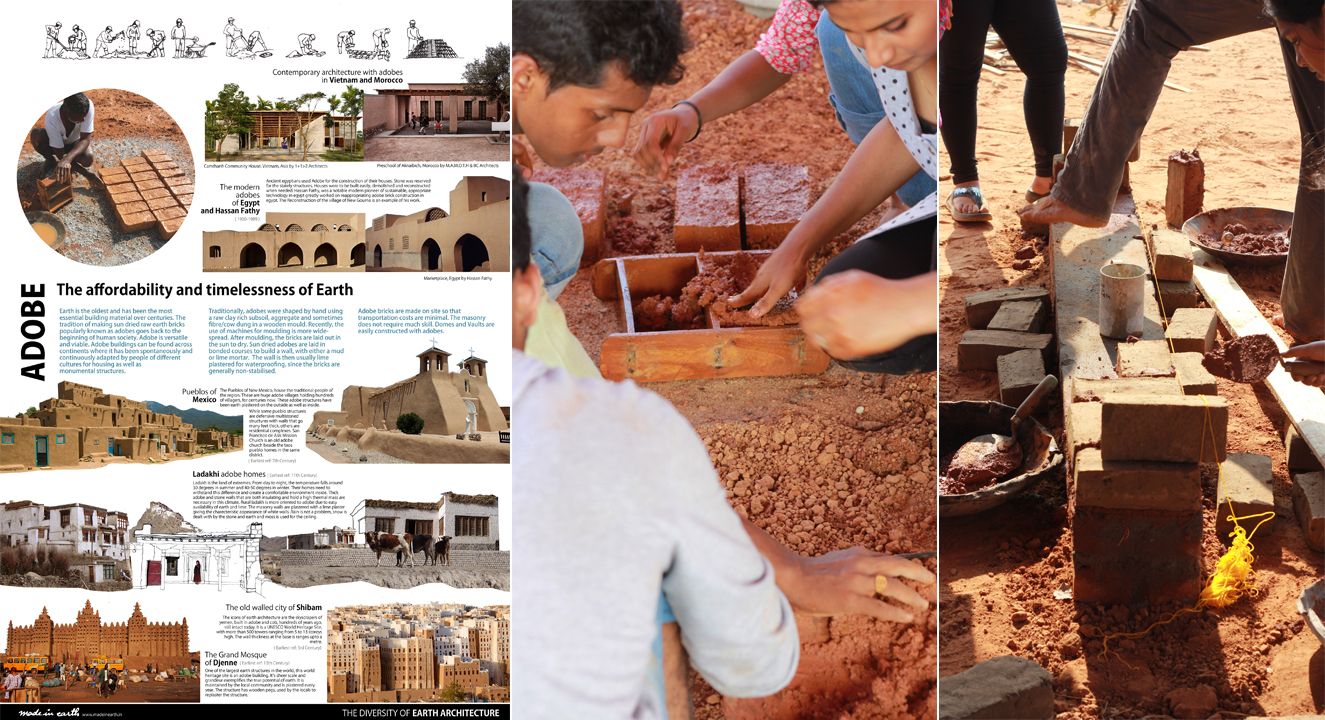
The Diversity of Earth Architecture

Earth is the oldest and has been the most essential building material over centuries.
The tradition of making sun dried raw earth bricks popularly known as adobes,
goes back to the beginning of human society.
Adobe is versatile and viable.
Adobe buildings can be found across continents,
where it has been spontaneously and continuously adapted
by people of different cultures,
for housing as well as monumental structures.


Archcult-Adobe

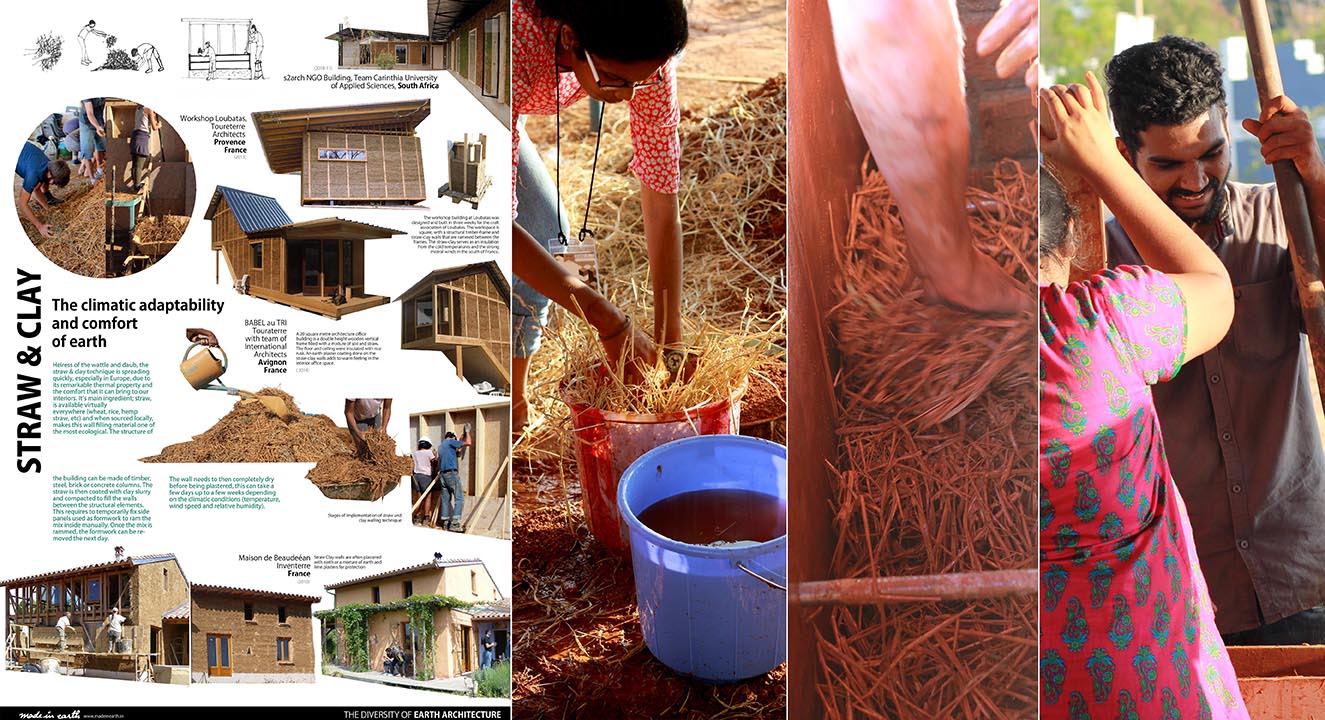
Heiress of the wattle and daub,
the Straw & Clay technique is spreading quickly, especially in Europe,
due to its remarkable thermal property
and the comfort that it can bring to our interiors.
It’s main ingredient; Straw, is available virtually everywhere
(wheat, rice, hemp straw, etc)
and when sourced locally,
makes this wall filling material one of the most ecological.


Archcult-StrawClay

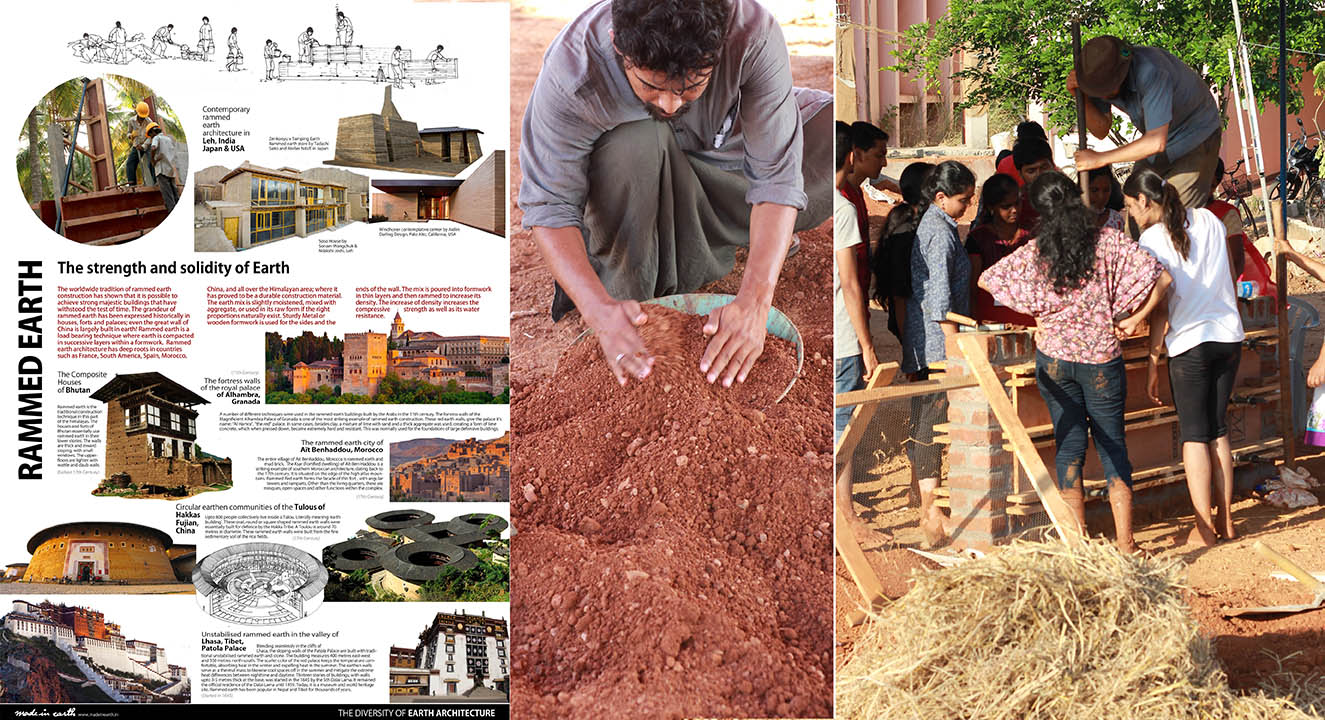
The world wide tradition of Rammed earth construction
has shown that it is possible to achieve strong majestic buildings
that have withstood the test of time.
The grandeur of Rammed earth architecture has been expressed historically
in houses, forts and palaces;
even the great wall of China is largely built in earth!
Rammed earth is a load bearing technique where earth is compacted
in successive layers within a formwork. 
It has deep roots in countries such as France, South America, Spain, Morocco, China,
and all over the Himalayan area;
where it has proved to be a durable construction material.


Archcult-Rammed earth


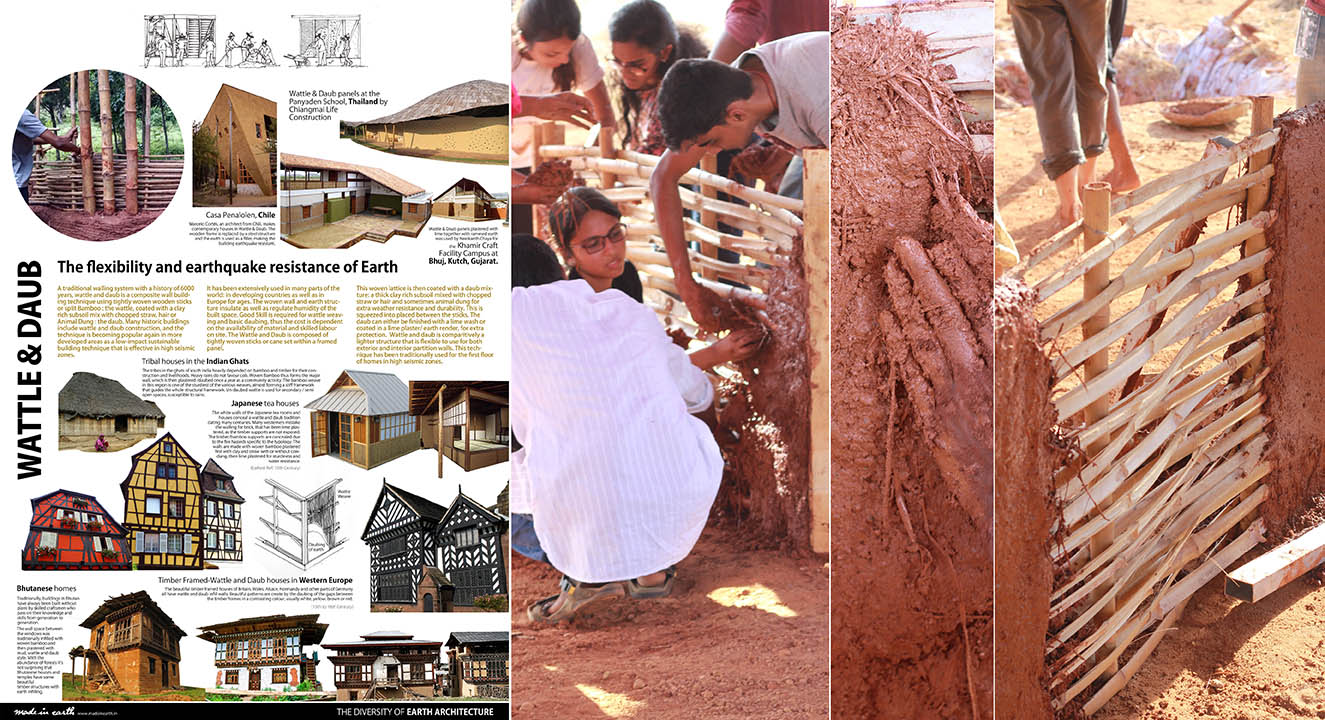
A traditional walling system with a history of 6000 years,
Wattle and Daub is a composite wall building technique
using tightly woven wooden sticks or split Bamboo : the Wattle,
coated with a clay rich subsoil mix,
with chopped straw, hair or Animal Dung : the Daub.
Many historic buildings include Wattle and Daub construction,
and the technique is becoming popular again in more
developed areas as a low-impact sustainable building technique
that is effective in high seismic zones.

Archcult-WattleDaub

2015 Kashi Primary School, Adobe, Blog 1 comment on We imagine a school, in Earth

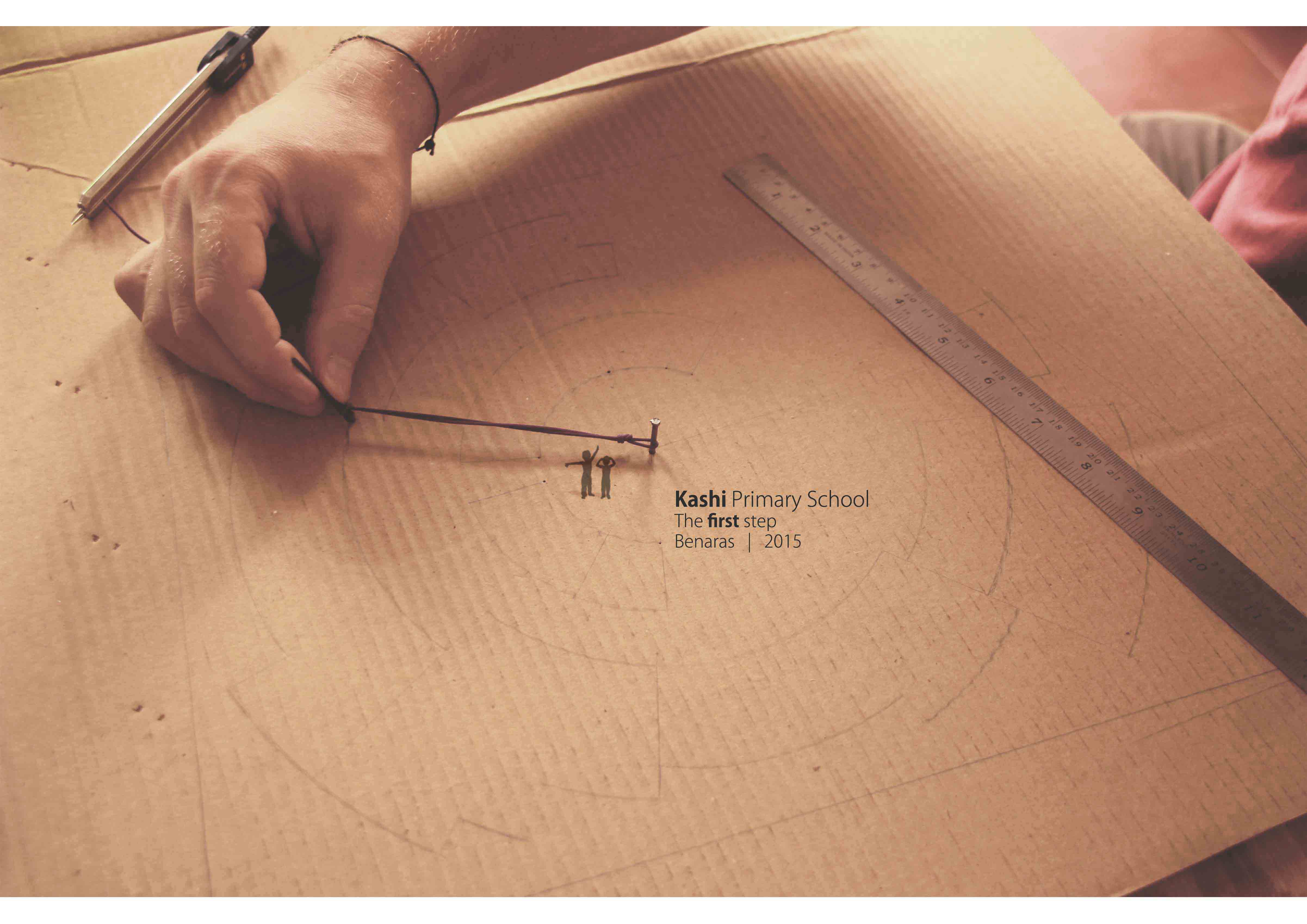
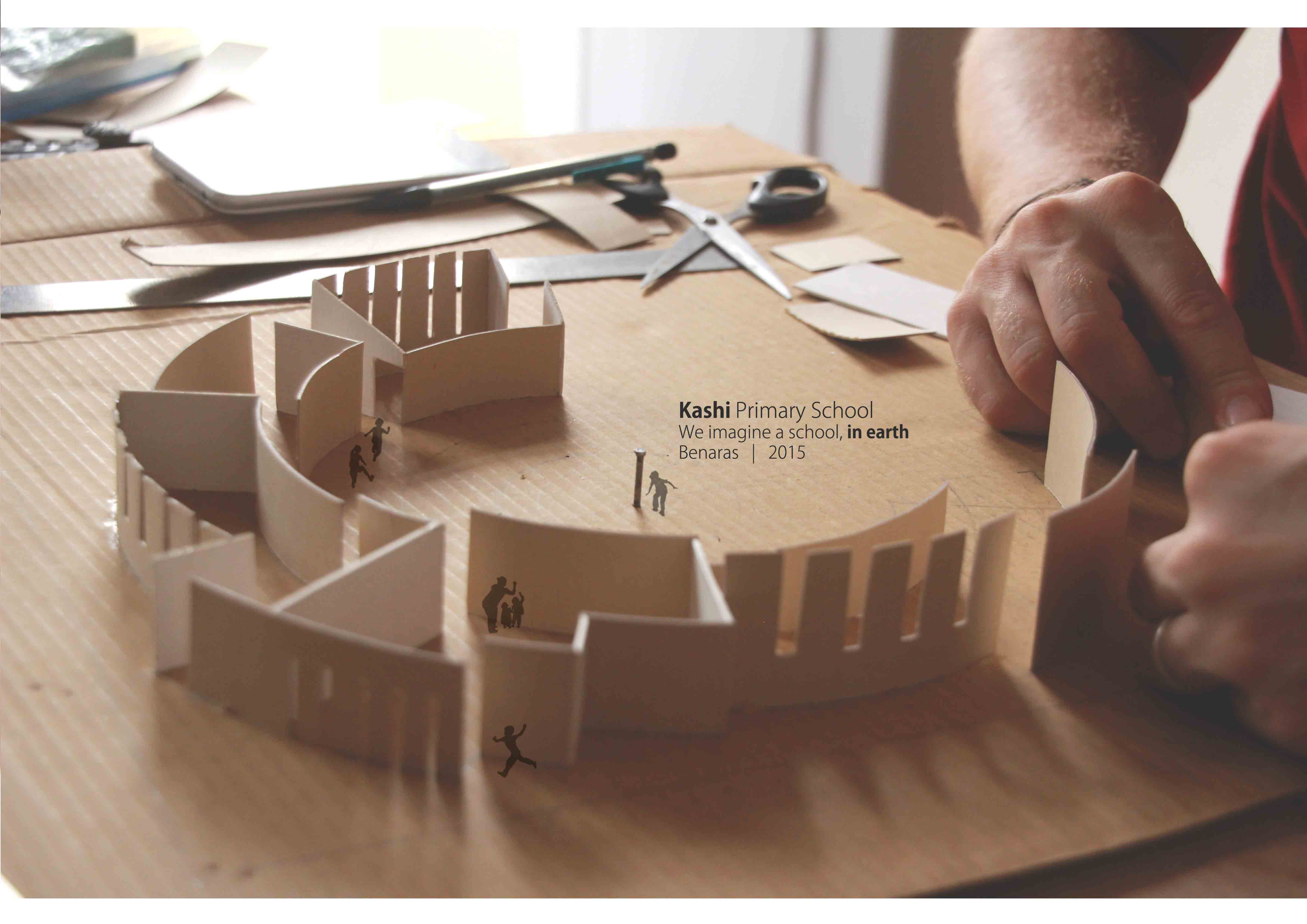
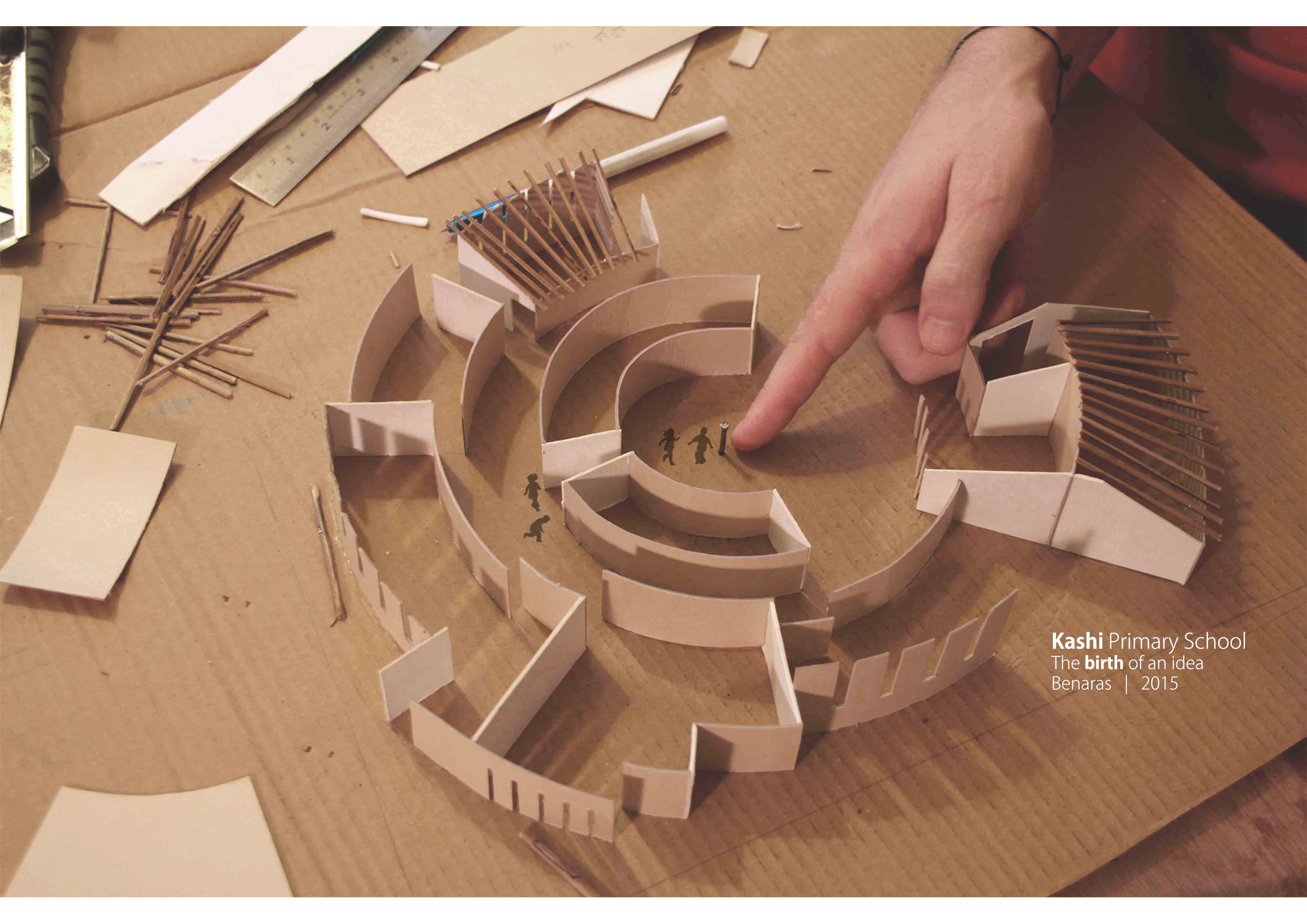
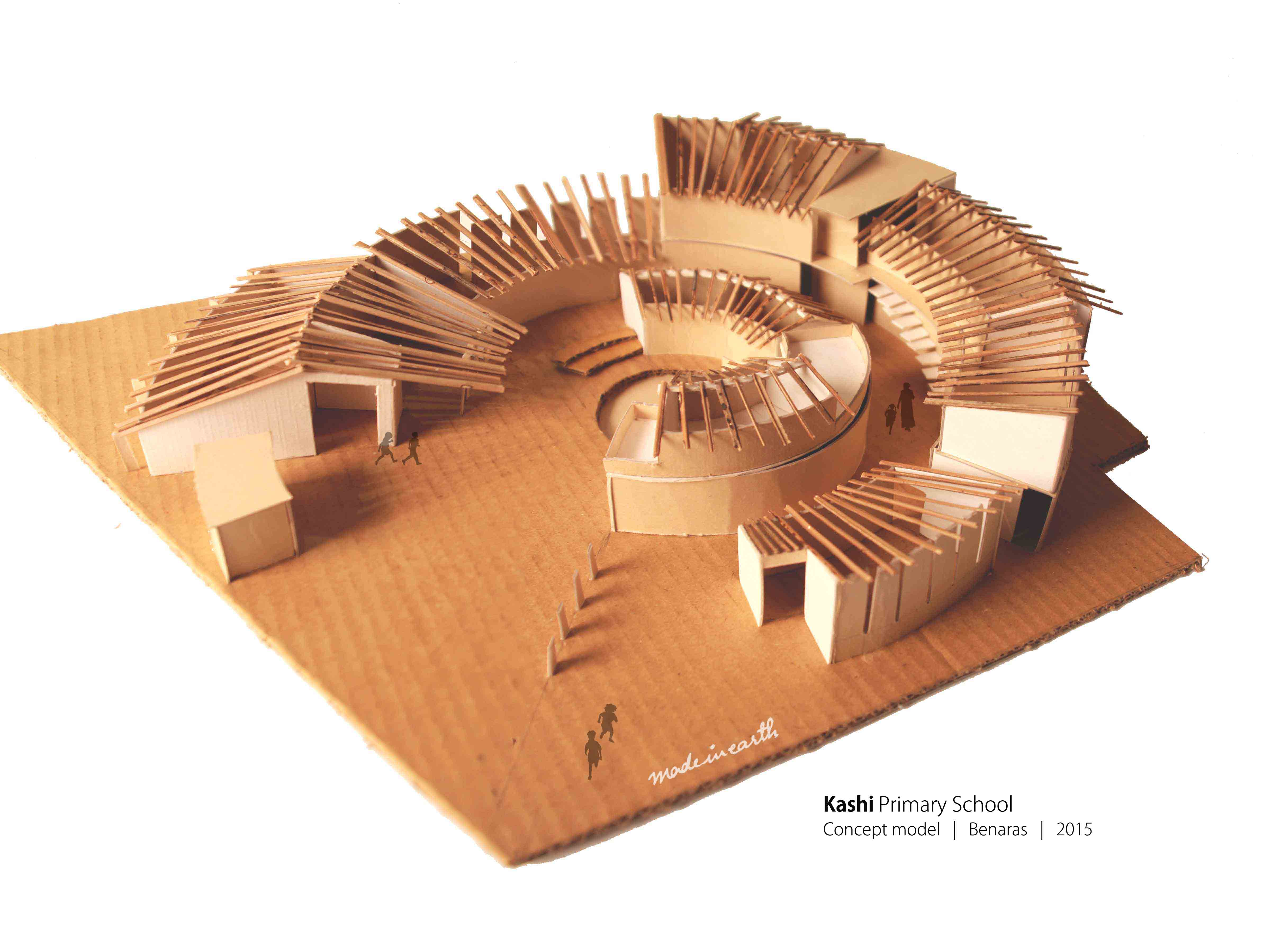
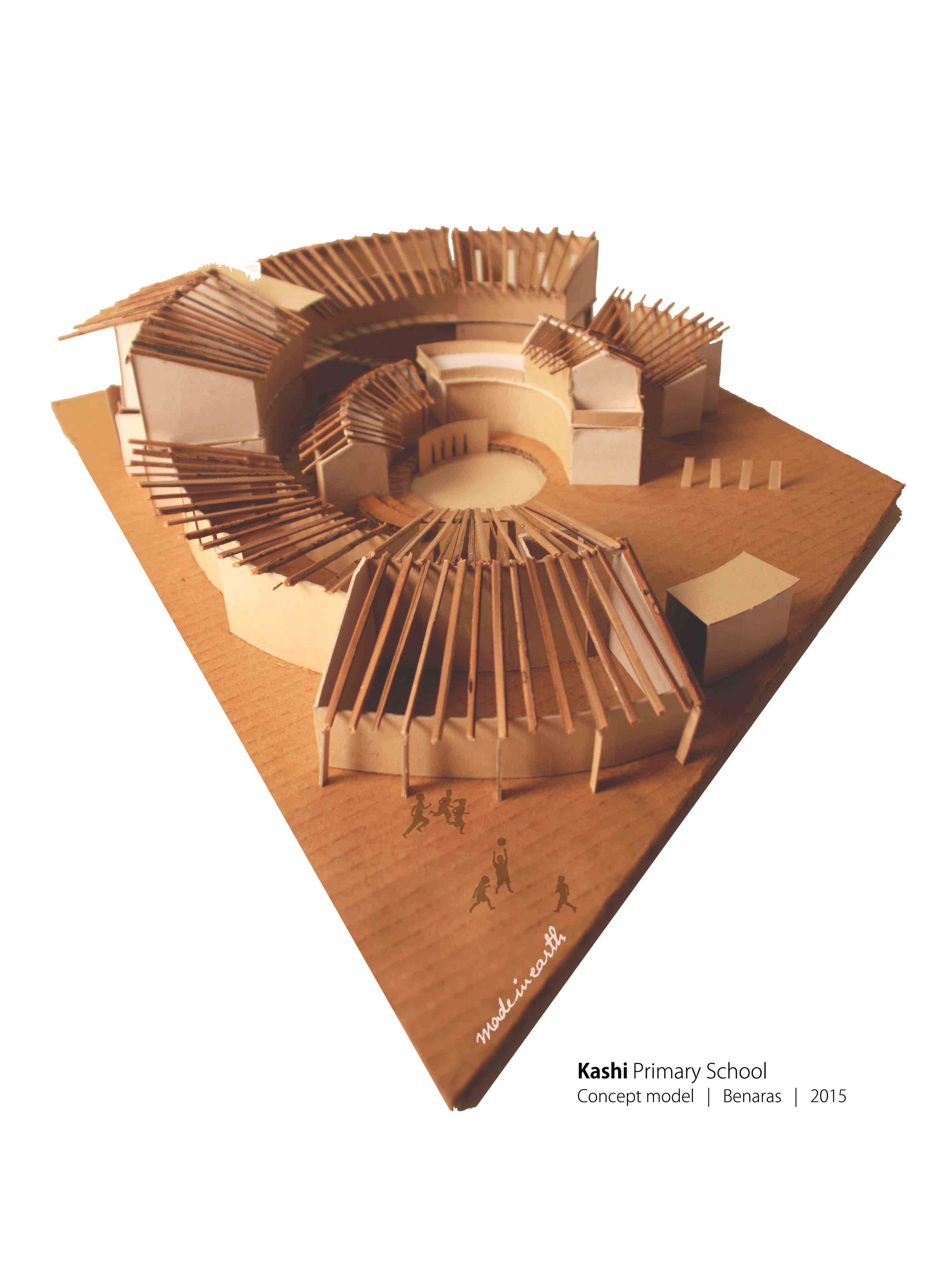
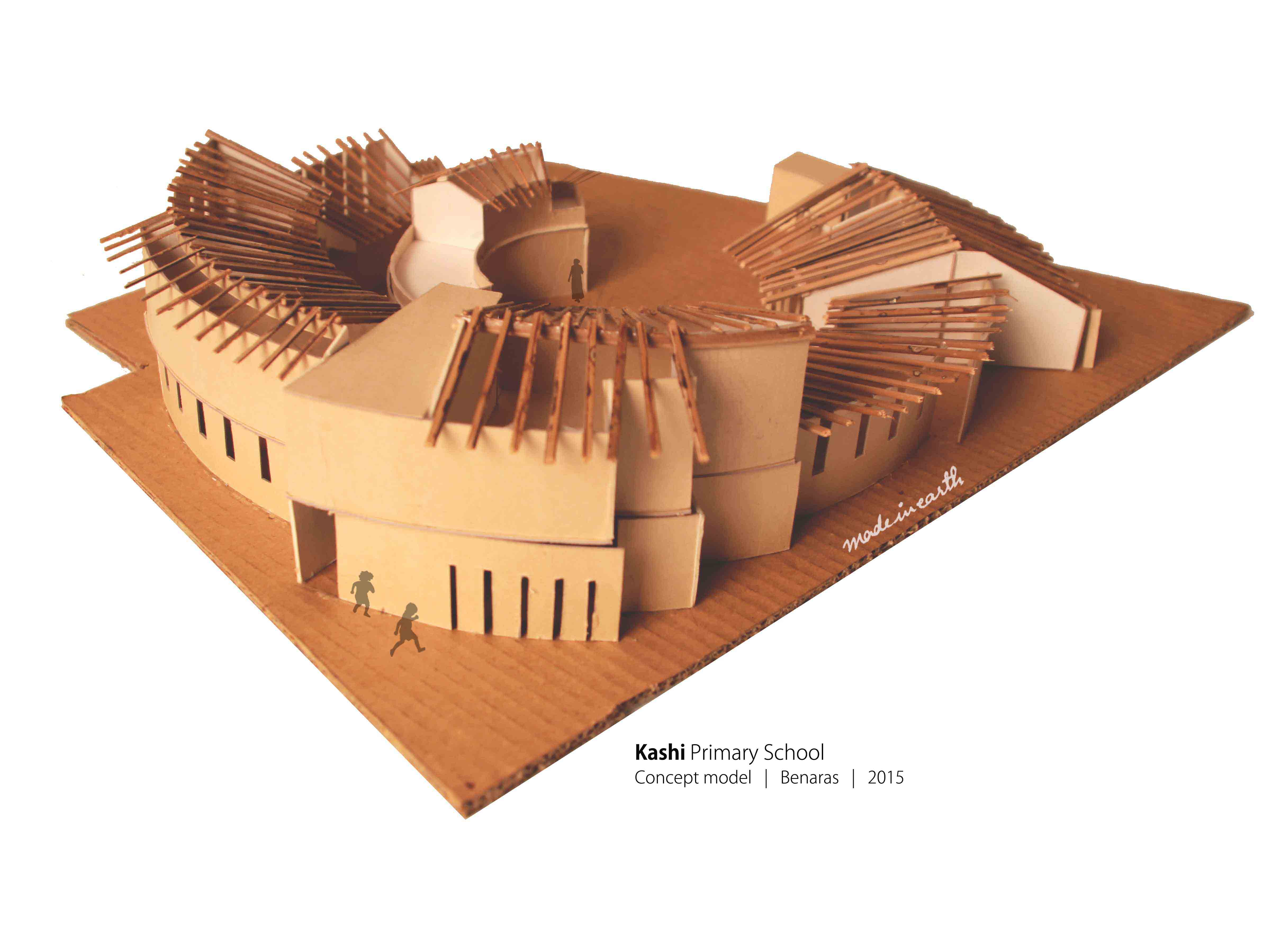
We imagine a school, in Earth

“For us, it goes in circles, move and continue, and move and continue and keep moving.”– This brief from the team at Kashi Education Society came a long way in shaping our design process.

We imagine children running, walking along walls, a casual finger trailing a texture or a motif along a wall, stopping to peep through a little window unto the green fields, escaping into a class and resurfacing somewhere else, oblivious to the building around them.

Benaras 01c

Benaras 01d

Benaras 01e

Benaras 04a

Benaras 04b

Benaras 04c

2015 Shubha Suma Farmhouse, Adobe, Blog, Earth Floors, Earth Plaster, Lime Plaster, Natural Plaster, Tadelakt

2015 Cute and Care


Suma and Shuba are two sisters from Bangalore with secret alter egos. They are setting up an organic farm near the small village of Seegehalli, in the outer reaches of the city. The quaint farm is a 400 m long strip of land jeweled with a row of coconut trees on either side. They dream of eventually retiring here to a quieter and more natural lifestyle. We have started to visualize the basic requirement for life on the farm. Nicknamed ‘Cute’ and ‘Care’ by our interns, the two cottages would be the first step in realising Suma and Shubha’s dream. The ‘Cute’ cottage is to accommodate the two on their weekend visits and enable them to spend more time on the farm, while the ‘Care’ cottage is to house a small family who would be present to take care of the farm at all times. It seems to us that this is the perfect place for a small adobe home, as we have wonderful soil as well as a local skill set to produce Adobes. Follow this thread to see how these designs evolve as we walk Suma and Shubha, gradually towards their dream.

2015 Cute and Care

2015 Build the Cuckoo School, 2015 Cuckoo Forest School, Adobe, Arches Vaults Domes, Blog, Workshops 6 comments on Stars in mud mortar

Stars in mud mortar

Then came Kali, he gave me a hundred kisses on my cheek, I hugged him and did not let him go. He was excited. He was one of those to whom the school belonged.
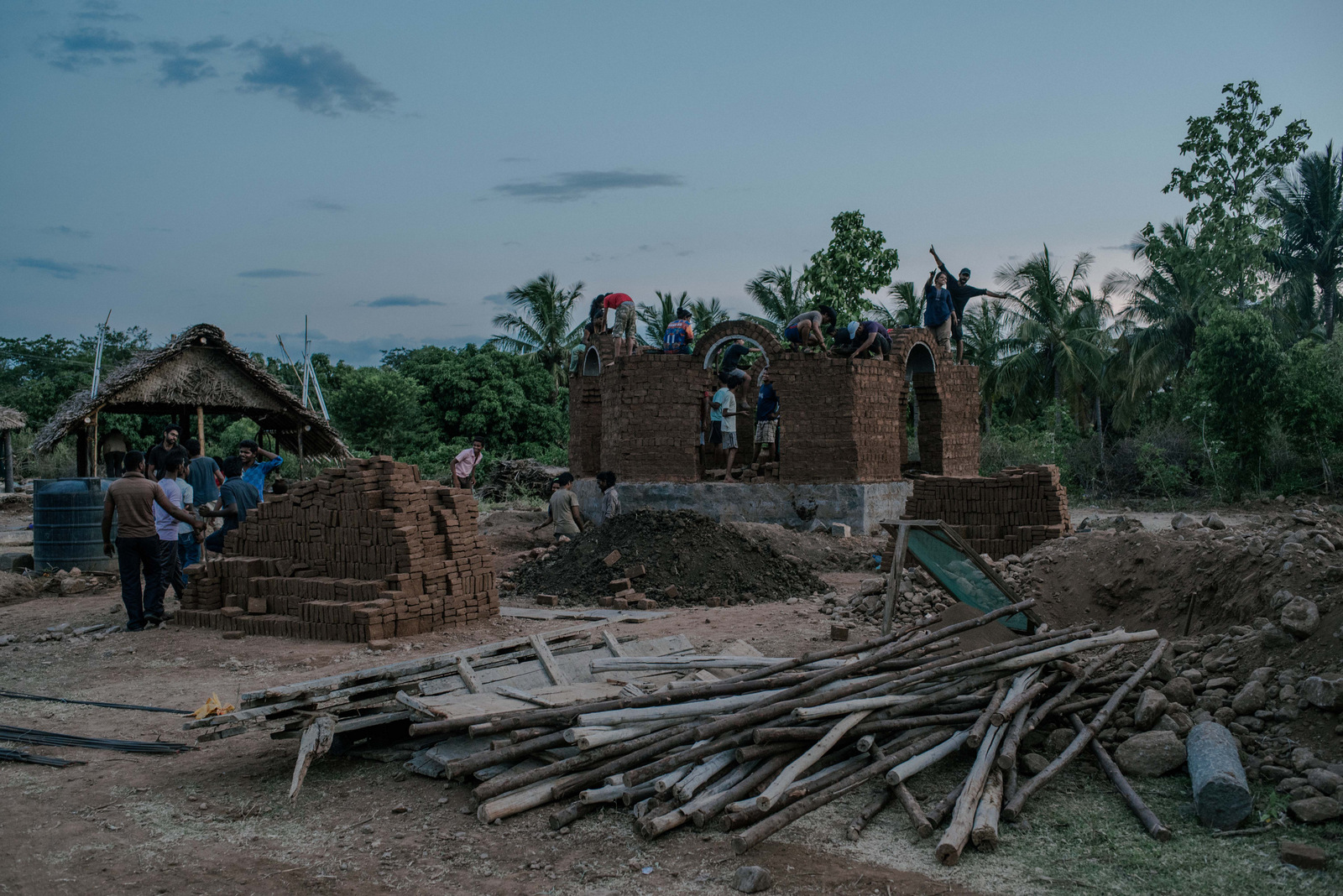
I had been waiting on the rope bed for one of my friends to ask for a brick or some mortar. We were constructing a Nubian vault, over the toilets. The arch, to be extruded, was beautiful. We were constructing portions of the much awaited Cuckoo Forest school.
_DSC1375
_DSC1392
_DSC1410
_DSC1618
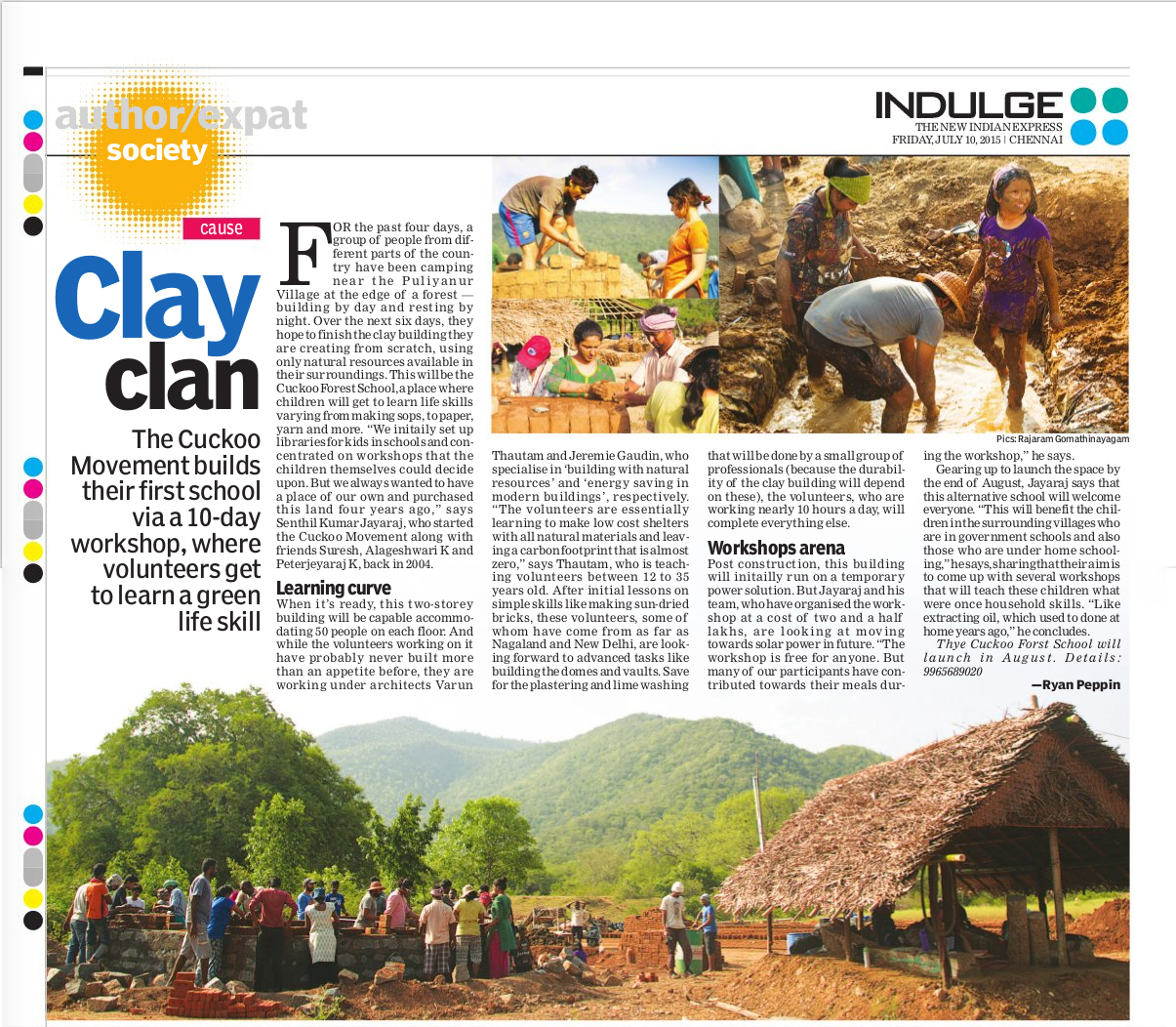
Cuckoo being an NGO, needed help to make this dream come true. And help came, it came from far and wide, from as far as Nagaland and Delhi. The soon to be ‘never forget me’ friends came together to put up the dome form.
We had just started to intern with Jeremie, who had been incessantly guiding the architecture/ construction, for the whole week. Work had started on the 5th of July 2015, under Varun Thautam, another earth conscious architect.
_DSC0976
_DSC0982
_DSC0961
_DSC0938
_DSC1079
I turned to see into the kitchen, Azhageshwari akka, our superstar, whose kitchen churned out the most amazing meals right from the morning herbal tea, to the fibre rich breakfasts, and full fledged lunches and dinners, complete with fried appalams.
_DSC0882
Some volunteers, I had seen in the morning, were collecting firewood for cooking. The bamboo in the forest, rustled as they had moved past me, not knowing my incognito-doing, closeby.
_DSC0817
_DSC1260
_DSC1117
The place had so much life, so much aura. The energies were quite literally flowing from every direction. The people and their stories made me feel minuscule. People were there not only to give a hand at the construction, I understood.
They were of varied professions: Architects, Engineers, IT professionals, farmers, psychologists, journalists, photographers, theatre artists, entrepreneurs, writers, even aspiring cricketers. No two artists had the same story to tell. They all seemed to be exuberantly glowing in their own ways. No two volunteers had the same reason to come.
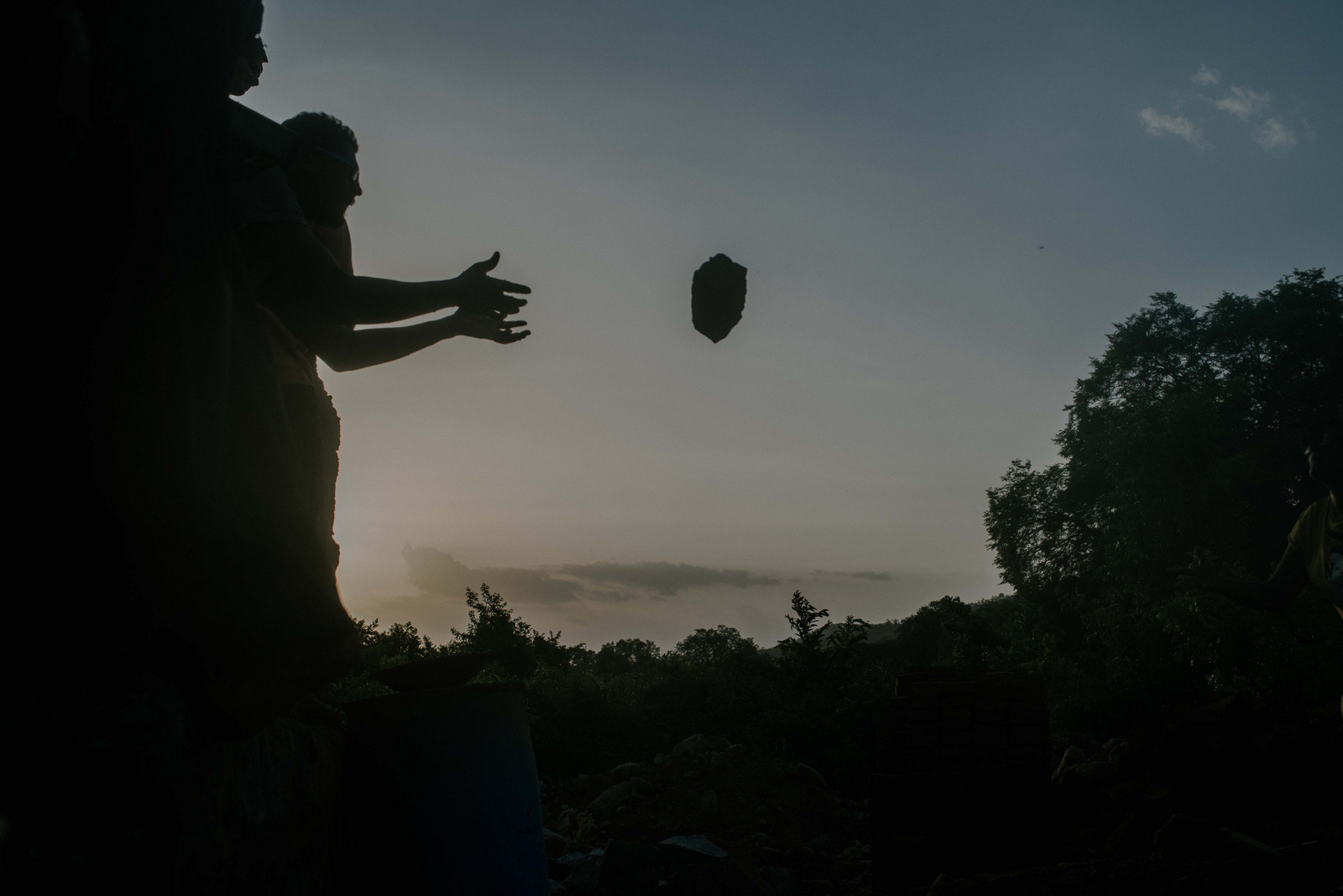
But all of them had one thing in common. They cared. They valued something. They valued earth.
_DSC1607
_DSC1083
Earth construction was perhaps the most apt technique. Five brick makers had made 4000 bricks a day, before I had reached the site. Eight volunteers churned out eight wheel barrows of clay mortar, each day, as they got themselves muddy pedicures. The work went on till lunch, and continued after tea. The happy ice-cream man had been having the time of his life, as we all craved, for the frosty sugar, under the flame thrower in the sky.
_DSC1624
_DSC1510
_DSC0993
_DSC1818
_DSC1307
_DSC1076_DSC1788
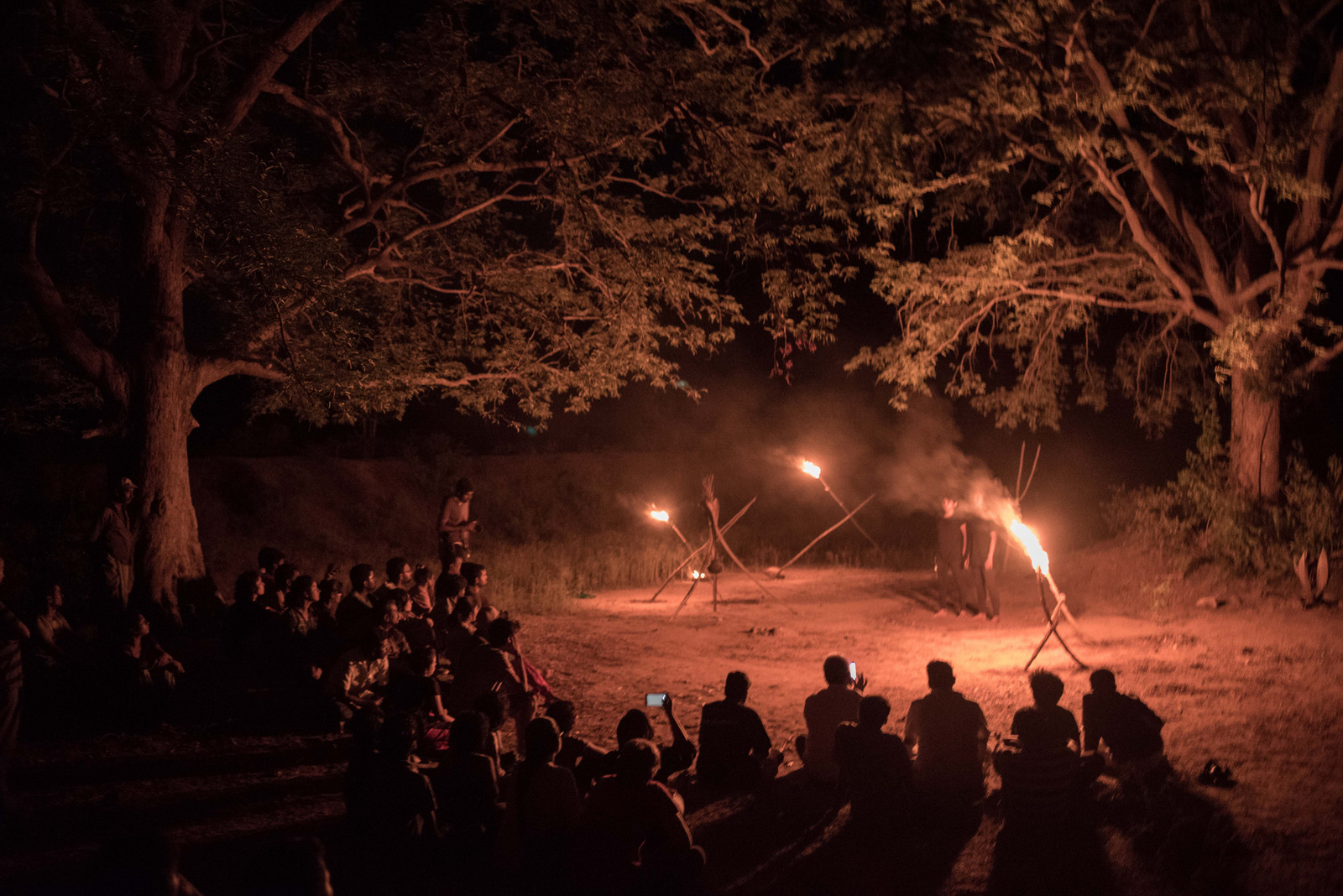
That night was the last night, under the serial lights of the deep sky. Moon rise, star song, what beauty, I felt in the reflection of my view. The void seem to grow, more and more, as talks of parting, seem to hang in the air. Poetry and theatre in the dead dark forest came alive with the vermilion of flames and echoes from within. The passion seemed to consume everyone from the inside out. And it ended, with deep question.
_DSC1764
_DSC1740
Indeed, the cuckoo volunteers served a lot of revered love to us. It is this love that has drenched children like Kali in. I felt so small in the company of the mighty mountains, the tall trees, most insignificant when I was shown their huge hearts and ever open minds. I feel I took so much more from cuckoo than I could have ever given.
I paid reverence to the land by sprinkling seeds and spreading life.I felt something very new, something that I can never describe when I removed my sandals that day. The Earth was breathing heavily under me.

By Santosh Shyamsunder, Team Made In Earth
_DSC1636
Photographs by Kaveer Rai
The Cuckoo Forest School brought together 40 volunteers from all over INDIA to build a handmade adobe school at the foothills of Javadhu, Puliyanur village in 10 days. Read more about the project here
Read an article about Cuckoo Forest School in the New Indian Express here


2014 Restoration of a countryside home, France, Adobe, Blog, Earth Floors, Earth Plaster, Lime Plaster, Natural Plaster, Tadelakt

Making an earthen floor

Most people often remember earth as a crude material; it’s plain looks that are so contrasting from the aesthetics of finished industrial products. But the irony is that the principle virtue of this material lies in its aesthetics, one that is natural, subtle and simple, adapting itself to the diversity of techniques, cultural aspirations and skills; sometimes in response to tradition, while sometimes contemporary. Along with the artisans from Inventerre, we used earth for a completely different purpose…earthen floors! Today we tell you how it was made :
1-Earth Floor

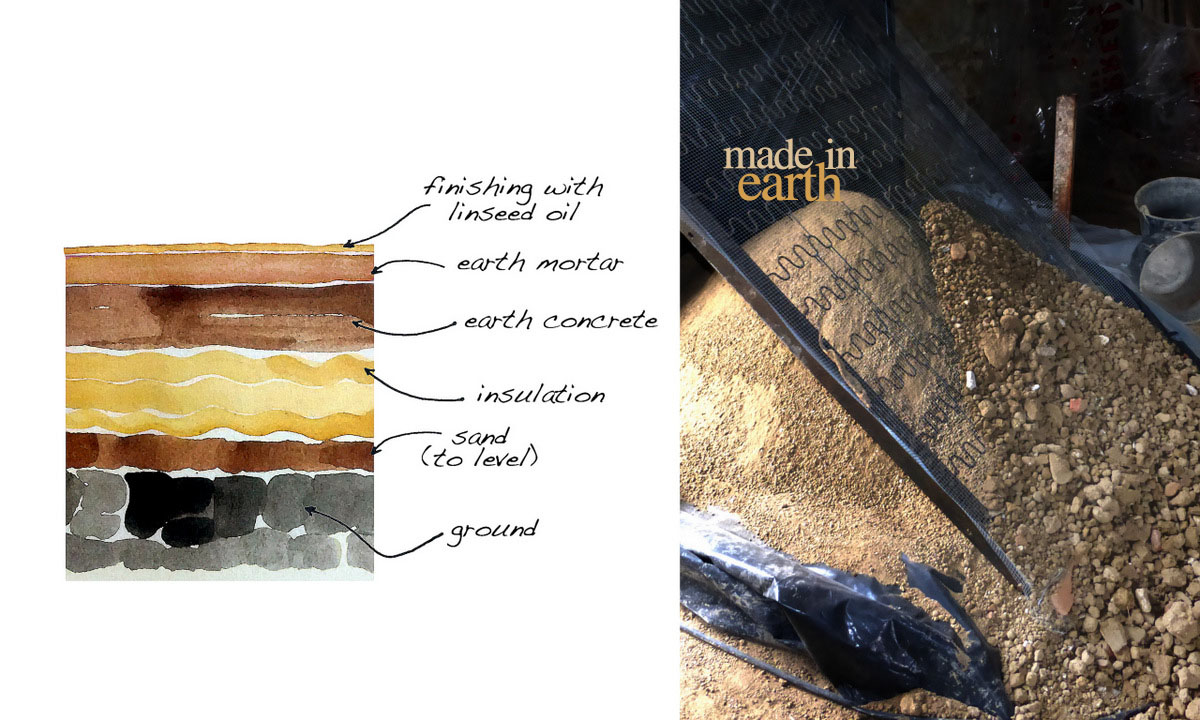
You are probably wondering : “Which layer did they stabilize? Where is the cement?”. There is no cement, no lime, no bitumen! Only earth and linseed oil!
1. First the floor was dug and leveled with a layer of 3 to 5cm of sand.

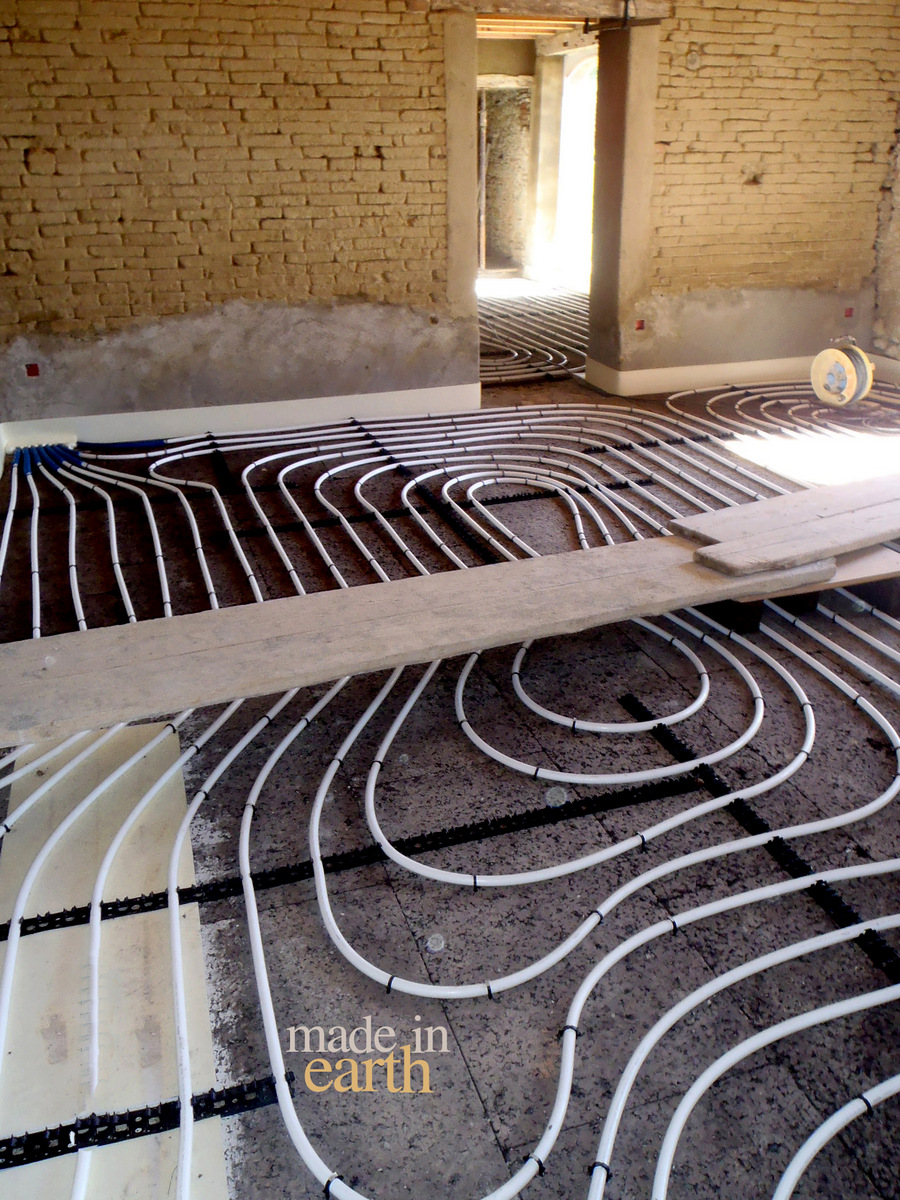
2. Next, a 10 cm of cork board was laid for insulation purpose. Cork is a very interesting material in Europe for foundations since it is water proof, resistant to humidity and dense enough to carry some weight.

Earth Floor

The building heating system is done through the floor. Pipes are fixed on top of the cork and will be “trapped” in the slab to get the best inertia. As you can see on the photo a compression seal was also laid at the point of contact between the slab and the wall to avoid cracks and movement due to the changes of temperature of the floor complex.

3. Then comes the earth concrete. There is a debate with the word “Concrete”, we like to say that concrete is just a mix of aggregate together with a bonding agent and water. Therefore earth mixed with water is a concrete. Clay particles play the role of holding the aggregate together to form an solid mass.

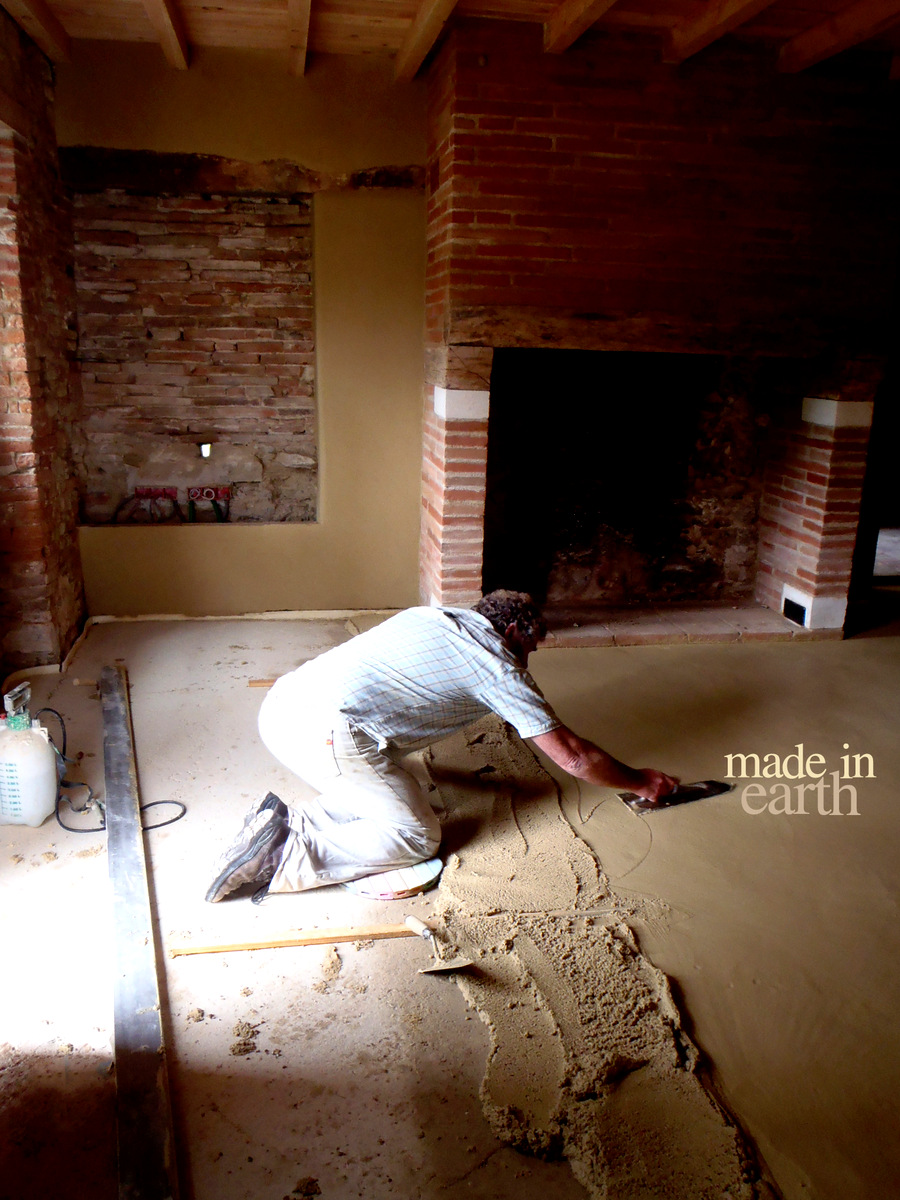
Several layers of 5 cm mix were applied and then rammed to reach a final slab thickness of 11cm. The mix is composed of : 3 vol of calcareous gravel + 2 vol of earth + minimum of water to reach a semi-plastic state. Each layer is rammed by feet first and then with a ramming machine.

Water is your best friend and your worst enemy when building with earth. Put little less and you won’t get any cohesion, put a little extra and you will have fissures. Even though we put a minimum amount of water, we had to wait 3 months for the entire volume to dry! It is not like cement which will react with the water, here most of the water needs to evaporate till the earth mix has found its water balance with the surrounding materials and the air.

Laying an earth floor

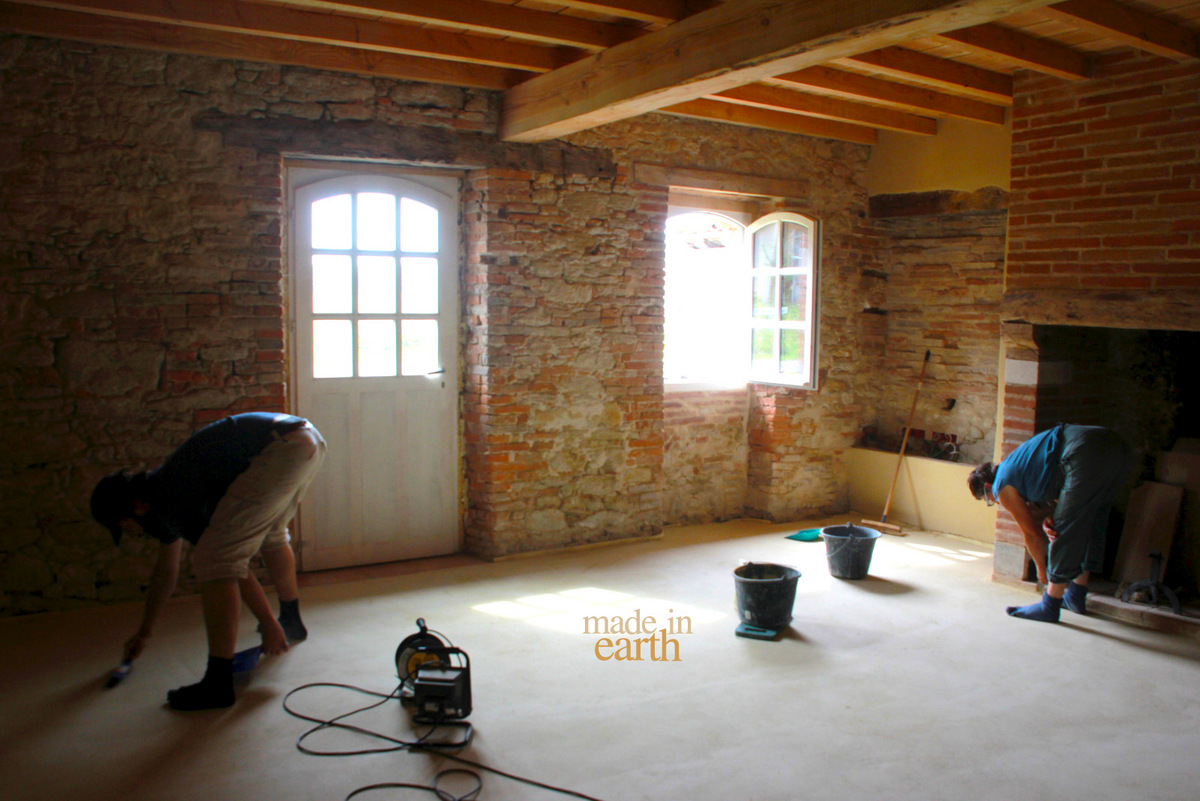
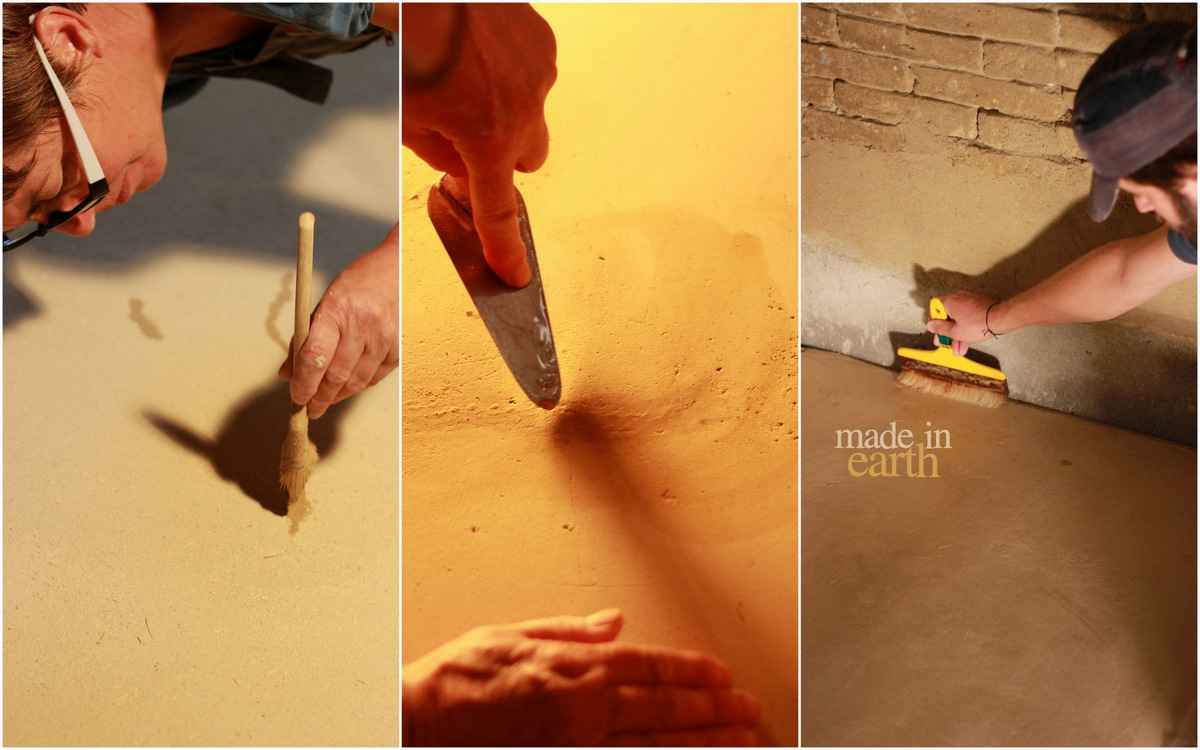
4. The earth mortar is the final layer. It is around 1.5 to 2cm thick and is composed of 4 volumes of calcareous sand (0/4) and 1 volume of earth. It is the layer that will be seen and needs to be “perfect”, the slightest crack is filled and fixed before the final coating.

Finishes

Earth floor laying

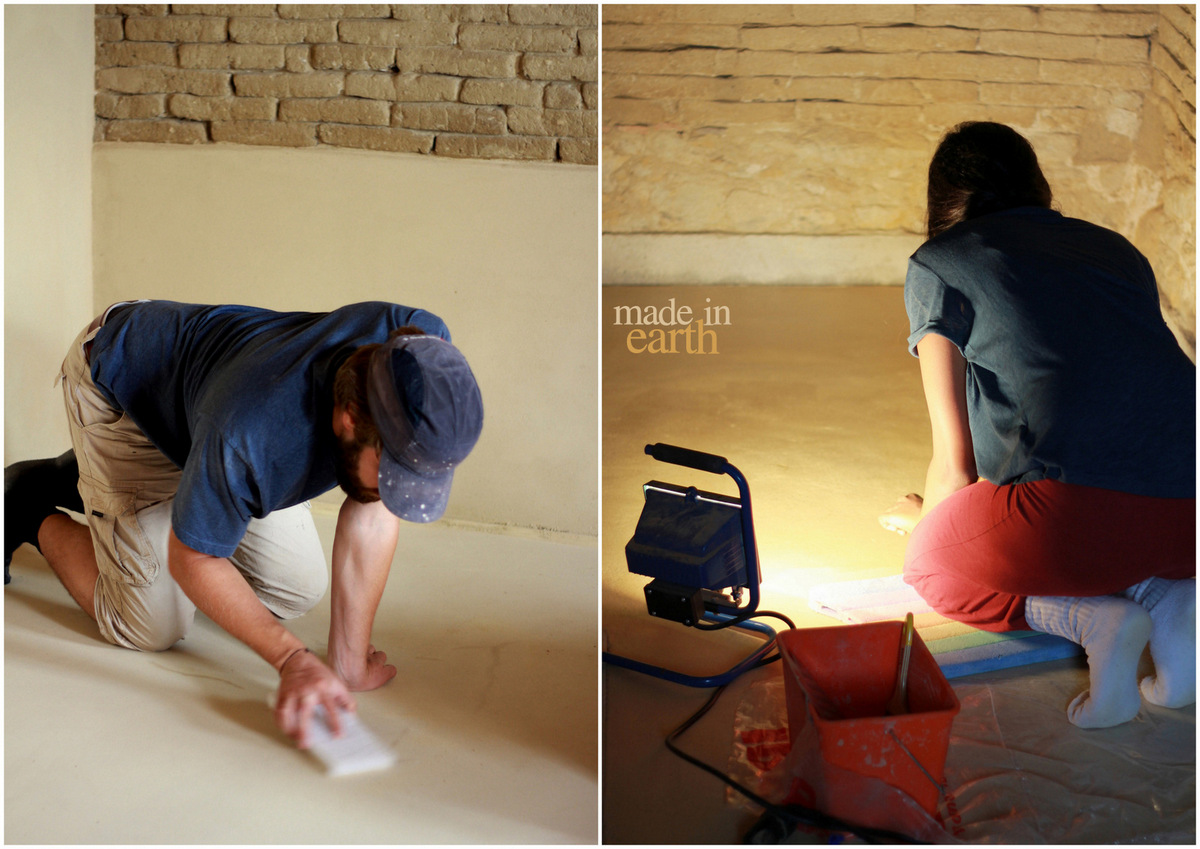
5. Linseed oil is then applied 4 to 5 times to give rigidity to the floor surface and to make it water proof.

Je and shru

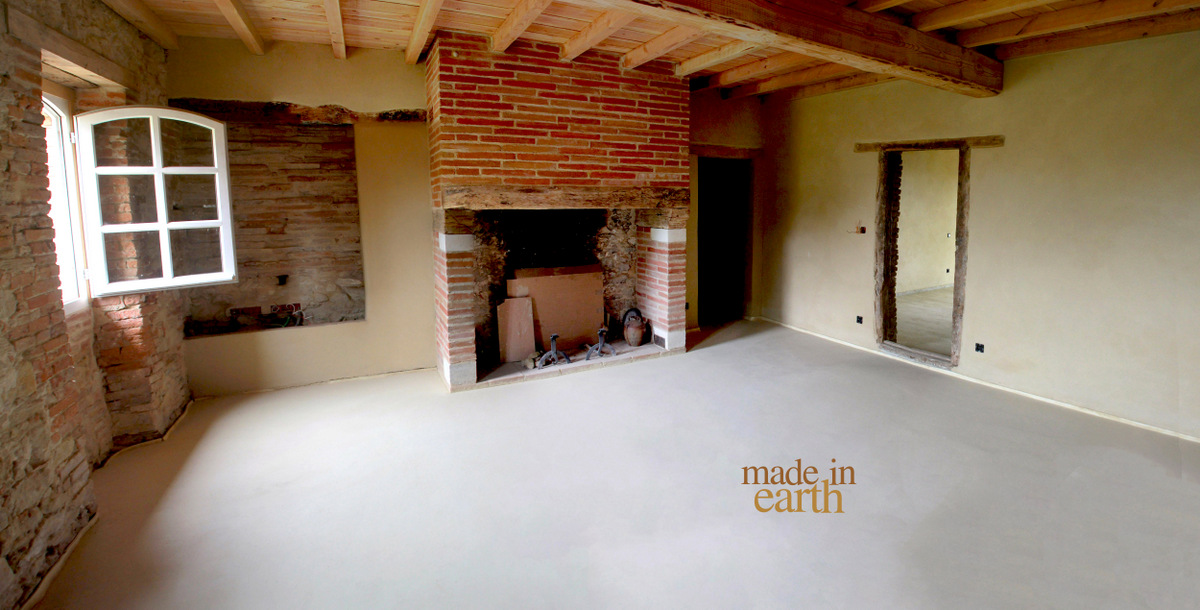
It is impressive to see that after applying the layers of oil, you can wipe the flour with a wet mop without altering the surface at all! Here is the final result!

7-Untitled_Panorama1

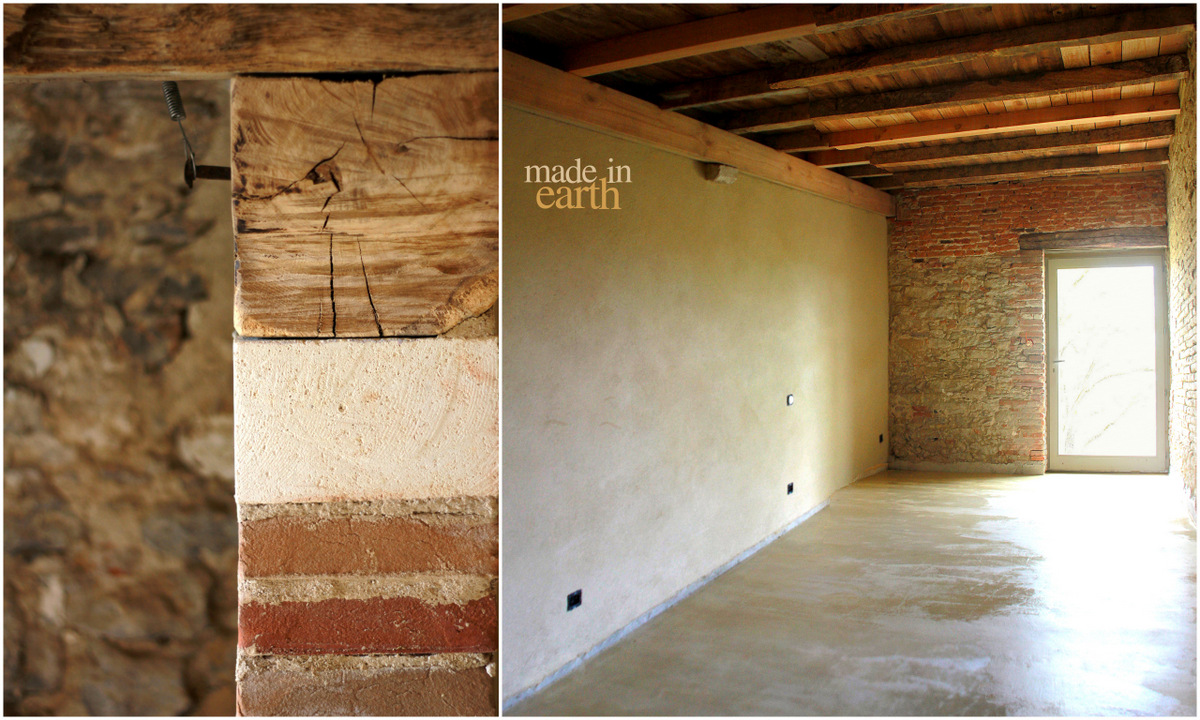
This is a restoration project of an old countryside house. The restored adobes, stone and cooked bricks and the wood are brought beautifully together by the earthen floor.

6-madeinearthband1

You have to really want an earth floor in your house. It may be most ideal for living areas, reading rooms or bedrooms while kitchens and other wet areas could be a challenge. Remember that having an earth floor in any part of your house requires a special attention. It is sensitive to shocks and point load. The linseed oil coat has to be renewed every once in a while to make sure that the floor does not take any stains. If you would like more information about earth floors, please write to us

Who is Inventerre? coming up soon.